The 3-3-3 rule for cats is something I share with every family that takes home a kitten from us — not because the adjustment is always difficult, but because knowing what to expect at each stage completely changes how you experience the first few weeks. Instead of worrying that your new cat seems off, you understand where they are in the process and what to do at each point. This post covers what the rule actually means and what it looks like in real life with real cats.
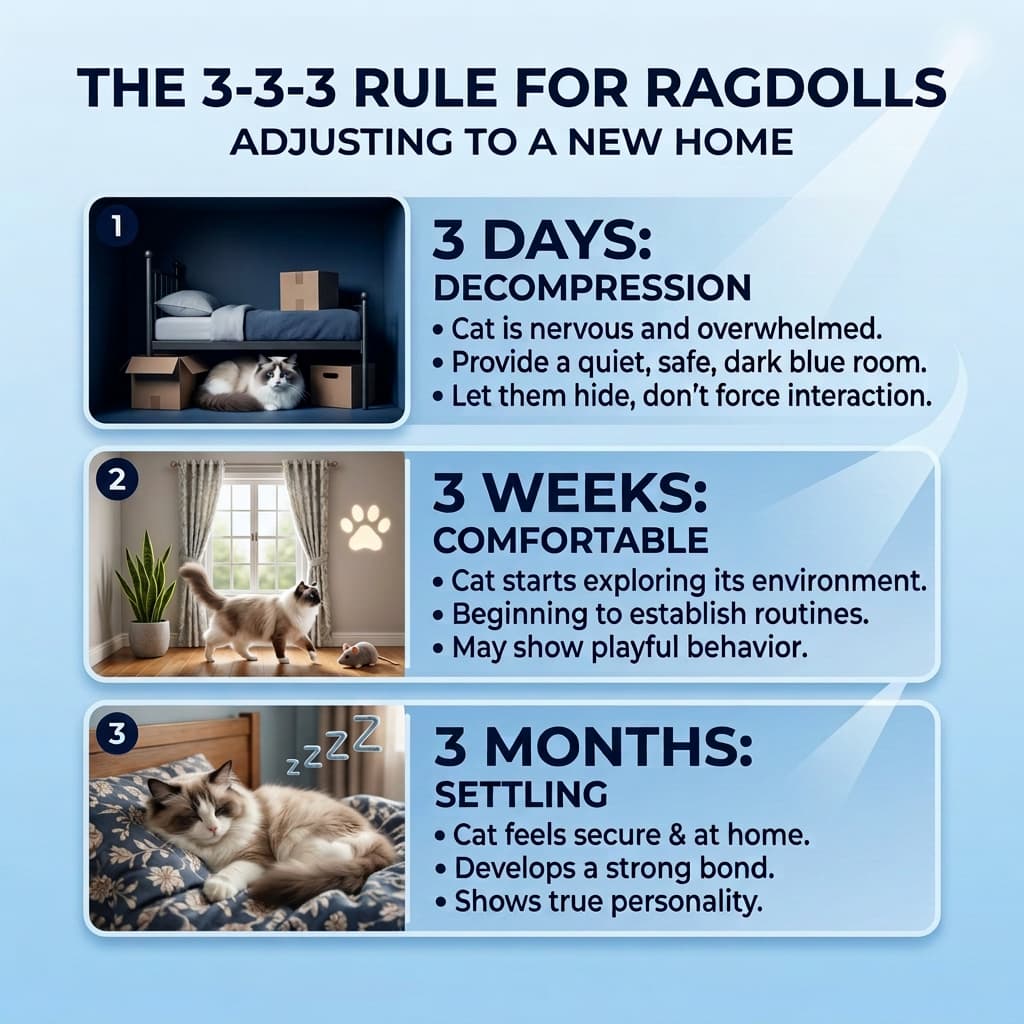
Table of Contents
What Is the 3-3-3 Rule for Cats?
The 3-3-3 rule for cats is a simple framework for understanding how a cat adjusts when they move to a new home. The idea is that adjustment happens in three distinct phases, each roughly tied to a time marker:
3 Days — Decompression
Your cat is processing everything. New smells, new sounds, new people, new layout. Most cats are quieter, more cautious, and less like themselves during this window. It doesn’t reflect who they actually are.
3 Weeks — Finding a Routine
Your cat starts to relax. They’re figuring out when food arrives, where they like to sleep, who they trust in the household, and what the daily rhythm looks like. Curiosity replaces caution.
3 Months — Fully at Home
This is when you see the real cat. The personality is fully out, the bond is established, and their behavior is consistent. The cat you have at 3 months is the cat you’re going to have.
The 3-3-3 rule originally comes from the dog rescue world and has been adapted for cats because the same core principle holds — animals need time to decompress in a new environment before their true personality comes through. Knowing this stops owners from panicking that their new kitten “seems different than expected” when really the kitten is just adjusting.
The First 3 Days — What to Expect During Decompression
The first 3 days after bringing a cat home are the adjustment window that surprises people the most. Your new cat or kitten has just left everything familiar — the scents of their previous home or cattery, the sounds they knew, the people and animals they were around. Even for a confident, well-socialized kitten, that’s a lot of new information at once.
Common things you’ll see in the first 3 days:
- Hiding or staying in one spot. They’re not sick or unhappy — they’re taking everything in from a safe position. A kitten tucked under the bed for a few hours is processing, not suffering.
- Eating less than you’d expect. Appetite often dips in the first day or two. As long as they’re eating something and drinking, this is normal. If they refuse food completely for more than 24 hours, call your vet.
- Being quieter or more reserved than the breeder described. This is probably the most common message I get — “he seems really shy, the breeder said he was cuddly.” Wait a few days. The cat the breeder described is in there.
- Sleeping a lot. Processing stress is tiring. Extra sleep in the first few days is normal.
- Being more clingy than expected. Some kittens go the other way and want constant contact from day one. Both are fine — cats decompress differently.
What you should do during the first 3 days: give them a quiet base (ideally one room to start, not the whole house), keep the environment calm, let them come to you rather than following them around trying to interact, and keep their food the same as what they were eating before. More on the food side in the food transition guide.

The First 3 Weeks — Finding Routine and Building Trust
By the end of the first week and through the first three weeks, most cats have moved past the initial decompression and are starting to feel genuinely comfortable. This is when curiosity takes over from caution.
You’ll start to see them exploring more of the home, initiating contact with you rather than waiting for you to come to them, playing properly, and establishing preferences — where they like to sleep, which person in the household they’ve bonded with most, what time of day they’re most active.
This is also the stage where Ragdolls and Cherubim cats really start to show that following-you-everywhere behavior. By week two or three, most of our cats’ new families are messaging me saying the kitten now comes to the bathroom door, sits on their lap in the evening, and basically hasn’t left them alone since day four.
- Start interactive play. Wand toys, crinkle balls, anything that gets them moving and engaging with you. Play is one of the fastest ways to build trust with a young cat.
- Gradually open up the house. If you started with one room, start letting them explore adjacent areas. Let them lead the pace — don’t push them into new spaces, just leave doors open and let curiosity do the work.
- Start a grooming routine. Especially for long-haired cats. A Ragdoll or Cherubim that gets used to brushing during this window will be easy to groom for the rest of their life. More in the shedding and coat guide.
- Keep routines consistent. Feed at the same times, keep the household energy calm, and give them a predictable rhythm. Routine is what makes cats feel safe.

The First 3 Months — The Real Cat Emerges
By the three-month mark, you’re living with the real version of your cat. The adjustment period is behind you, the bond is established, and their personality is fully visible. Whatever your cat is at 3 months — cuddly, playful, a bit sassy, obsessed with you, independent — that’s who they are.
For Ragdolls and Cherubim cats especially, this is when the depth of the attachment becomes clear. These cats form real bonds with their people, and by 3 months that bond is solid. Most families at this point can’t imagine life without the cat, and the cat has clearly made themselves the center of the household in the most charming way possible.

What We Actually See With Our Kittens
In my honest experience, most of our kittens adjust really well within the first 3 days — some even by the very next day. Because we socialize every kitten from the moment they open their eyes — handling them daily, keeping them in the middle of household activity, exposing them to different people and sounds — they go home already comfortable with people. The foundation is already there before they even leave us.
From Our Cattery — AquaMarine Kittens
Moe was settled by day two. Onyx looked like he’d always lived there from the moment he arrived. That’s not luck — it’s the result of consistent socialization from birth. When a kitten grows up in the middle of a busy household with regular handling and human contact, a new home isn’t as overwhelming as it would be for a kitten raised in a separate room with minimal interaction. The 3-3-3 rule is still useful for understanding the process, but for our kittens, that first phase often goes faster than the rule suggests.
Adult cats are a different story and tend to take longer, especially if their circumstances changed unexpectedly — a previous owner moving, a home situation shift, a shelter stay. Personality and temperament also play a real role. A bold, outgoing cat settles faster than a more reserved one, regardless of how good the socialization was.
Does the 3-3-3 Rule Apply to Adult Cats?
Yes — but the timeline is more variable. Kittens, especially well-socialized ones, often move through the phases faster because they’re at a developmental stage where adapting to new environments is natural. Adult cats, particularly those coming from shelters or from homes where something disrupted their routine, may spend more time in the decompression phase.
An adult cat moving to a new home might hide for several days rather than hours. It might take closer to 4 or 5 weeks before you see their real personality rather than 2 or 3. The 3-3-3 framework still applies — it just stretches in some cases. The key is patience and not projecting the decompression behavior onto who the cat actually is.
According to International Cat Care, giving a new cat a smaller initial space and letting them expand gradually is one of the most effective ways to reduce the stress of a new environment — which naturally shortens the decompression phase.
Kittens Adjusting to Dogs in the Same Home
If you’re bringing a kitten into a home that already has a dog, the adjustment timeline is a bit different. In my experience, kittens adjusting to a dog usually takes around a week before they’re genuinely comfortable — sometimes a little more depending on the dog’s energy level and how the introduction is handled.
- Keep them separated for the first few days. Let the kitten get comfortable in their own space before any face-to-face time with the dog. They’ll smell each other under the door, which is a low-pressure way to start the introduction.
- Do controlled introductions with the dog on a lead. First meetings should be calm and supervised, with the dog restrained and the kitten having a clear escape route. Don’t let the dog rush or chase — even playfully — in those first sessions.
- Give the kitten high spaces. A cat tree, a shelf, somewhere they can go that the dog can’t access. Having a physical escape option makes the kitten feel safe and speeds up the process.
- Keep sessions short at first. A few calm minutes of being in the same space, then separate them again. Build up the time as the kitten gets more comfortable.
- Be patient. A week is typical but some kittens take two or three. Rushing it almost always makes it take longer.
Practical Tips to Help Your Cat Settle In Faster
The 3-3-3 rule is a framework, not a fixed schedule. There are things you can do that genuinely move things along — and things that slow it down.
- Start with one room, not the whole house. A kitten that goes straight into a large open house with lots of rooms to explore can feel overwhelmed rather than free. One calm base room first, then expand gradually.
- Let the cat initiate contact. Sitting near them, talking to them quietly, and waiting for them to come to you builds trust faster than reaching for them before they’re ready.
- Keep the food the same for the first few days. A food switch on top of a home change adds unnecessary stress. We send kittens home with a small food supply for exactly this reason — keep them on what they know while they’re adjusting. You can transition food later once they’re settled. More in the food transition guide.
- Keep the environment calm. Loud music, lots of visitors, children running and shouting — all of these extend the decompression phase. The first few days especially, keep things low-key.
- Don’t stare or hover. Cats find prolonged eye contact and being watched constantly uncomfortable. Go about your normal routine, be around, and let the cat come to you on their terms.
- Forcing interaction. Pulling a cat out from under the bed, picking them up before they’re ready, or following them around when they’re trying to hide all increase stress and extend the decompression phase.
- Changing their food immediately. Digestive upset on top of a new environment is a bad combination. Wait until they’re settled.
- Introducing too many new people or animals at once. Give your new cat time with just the immediate household before introducing extended family, friends, or other pets.
- Expecting them to be “normal” in the first 48 hours. The first few days don’t tell you who your cat is. Evaluate them at 3 weeks, not 3 days.
Video
This short video is a good visual summary of the 3-3-3 rule for cats and what to expect at each stage.
Note: not our cats — included as a general reference on the 3-3-3 adjustment rule.
Frequently Asked Questions — The 3-3-3 Rule for Cats
Final Thoughts
The 3-3-3 rule for cats is useful because it reframes what the first few days actually mean. A quiet, cautious kitten in day one isn’t telling you who they are — they’re processing. The cat you see at 3 months is the real one. Everything before that is just the adjustment arc playing out.
For most of our kittens, that arc moves quickly because of the socialization work we put in before they leave us. Moe was settled by day two. Onyx looked at home from the moment he arrived. But even for kittens that take the full few weeks, the end result is the same: a bonded, confident, settled cat that has no idea there was ever a time when this wasn’t home.
Looking for a Ragdoll or Cherubim Kitten?
Raw-fed, TICA-registered, health-tested, and socialized from birth in our Virginia home. Our kittens go home ready to bond — and most are settled within days.
View Available Kittens