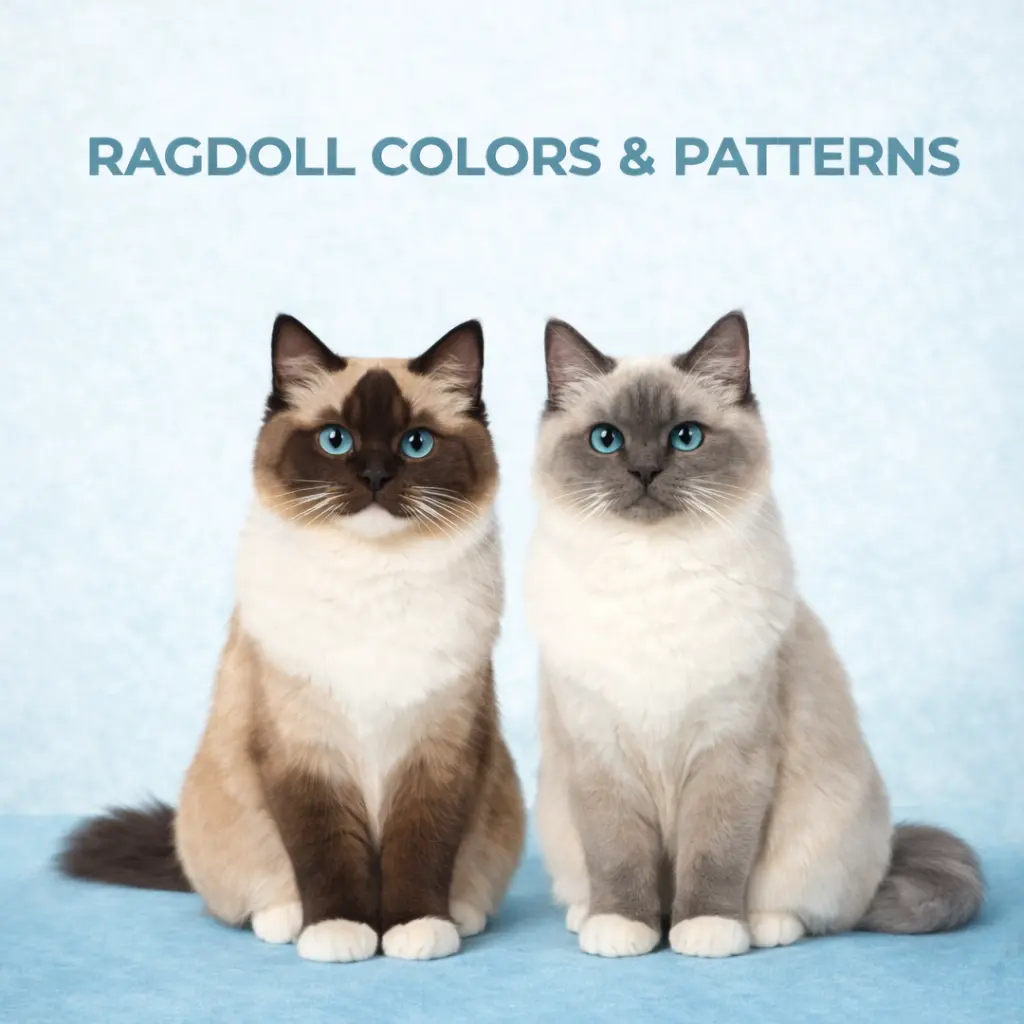
Blue Bicolor is the pattern I get the most questions about — that bold white V across the face next to the blue-gray points throws people off at first because it looks so different from a Mitted. Here’s everything I tell people about it, plus real photos from cats I’ve actually bred.
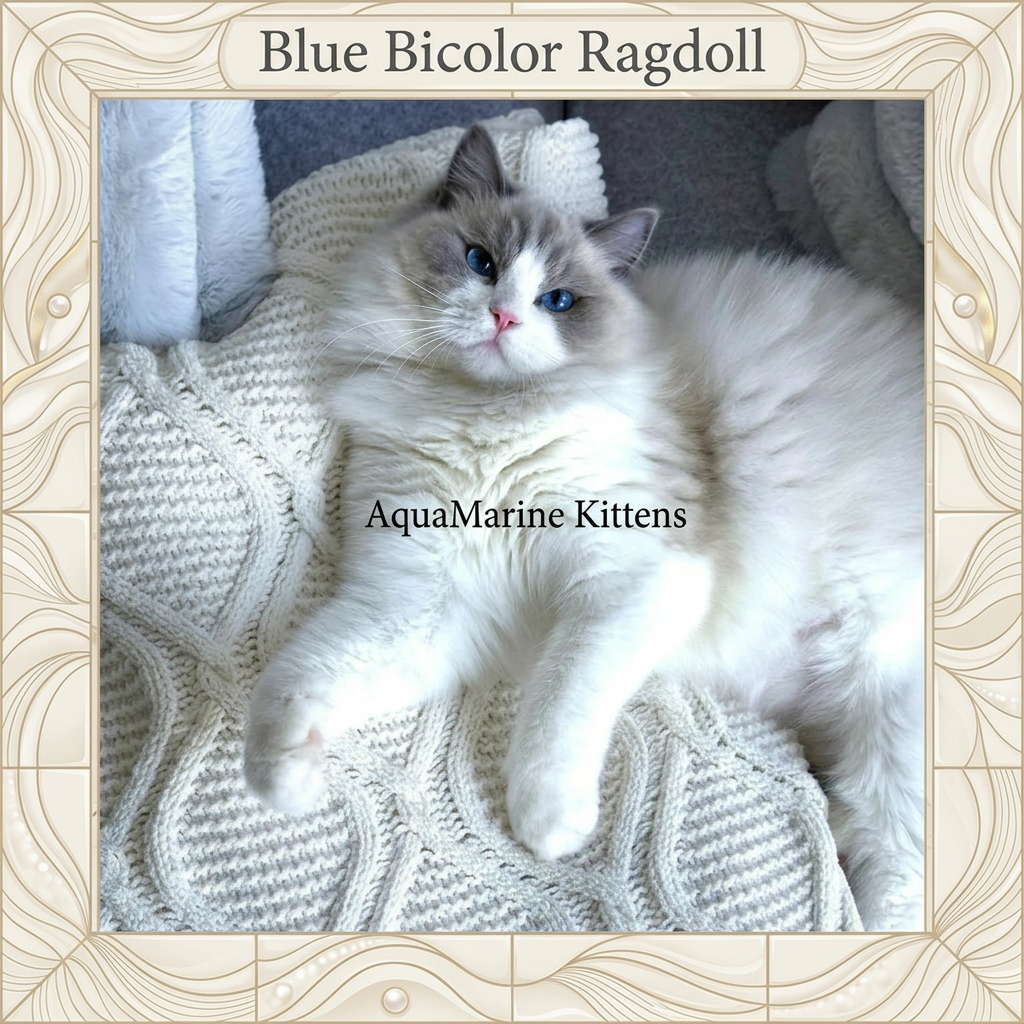
Table of Contents
What Is a Blue Bicolor Ragdoll?
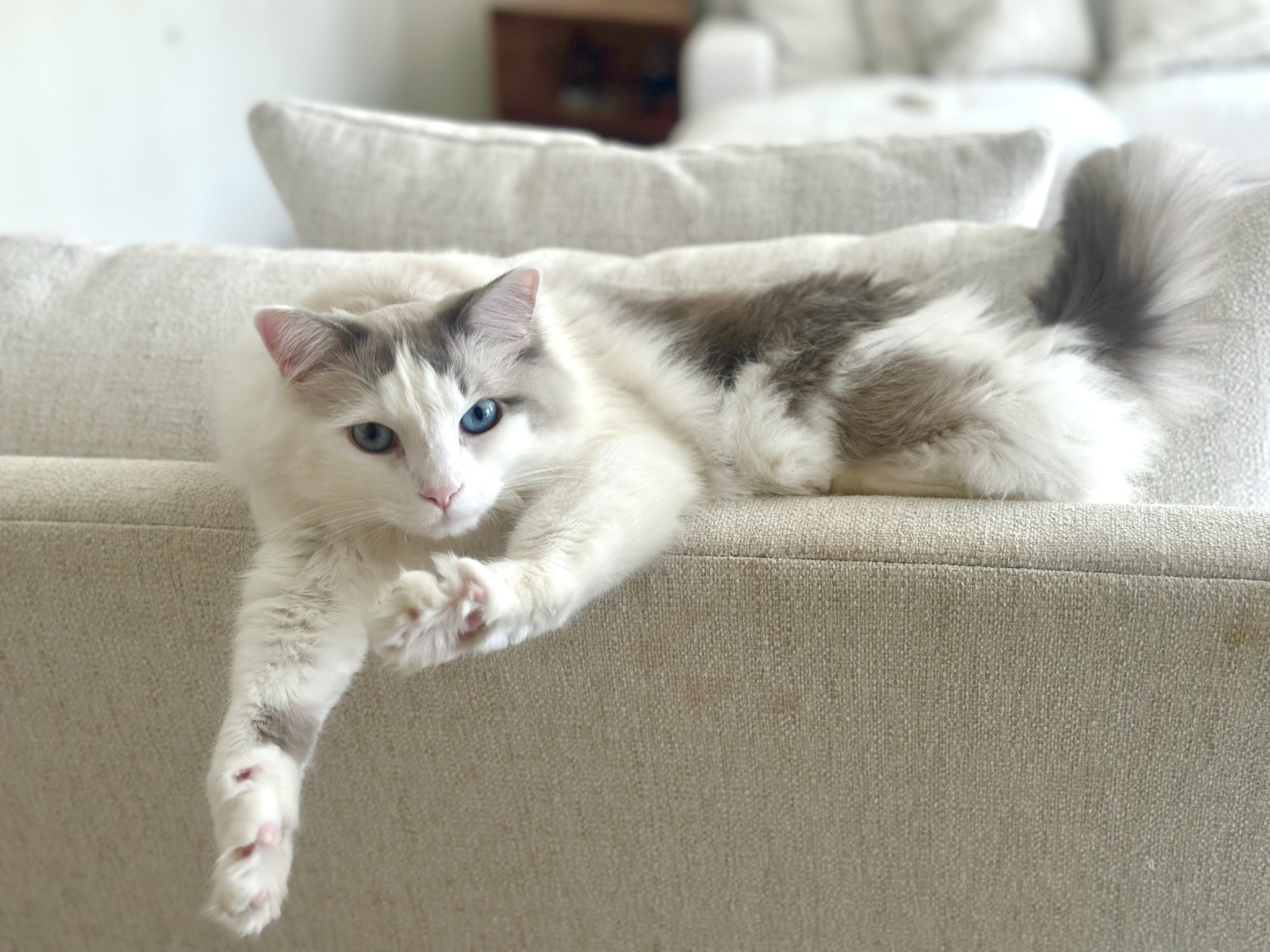
A Blue Bicolor Ragdoll is a traditional pointed Ragdoll with cool blue-gray points — ears, the outer parts of the face, legs, and tail — and a white inverted V marking that covers most of the face. The legs are white from paws up, the underbelly is broadly white, and the body is a soft cream. Eyes are always blue.
That’s the textbook version. In person it reads very differently than in photos — the contrast between that white face and the smoky blue-gray on the ears and back is sharper than most pictures actually capture.
Blue Bicolor Ragdolls — sometimes called Blue Point Bicolor Ragdoll cats — are fully recognized by TICA (The International Cat Association) under the traditional Ragdoll breed standard. They’re one of the most popular Ragdoll patterns precisely because that face marking is so immediately striking.
The Inverted V — The Defining Feature of Blue Bicolor Ragdolls
If you ask anyone what makes a Bicolor Ragdoll different, the answer is the inverted V. It’s the white facial marking that starts between the eyes and flares down and outward across the face. On a well-marked Blue Bicolor, it’s clean, symmetrical, and covers most of the face — nose, muzzle, cheeks — while the blue-gray point color stays on the outer edges of the ears and wraps down the back of the legs and onto the tail.
Not every Bicolor is perfectly marked. In any litter you can get variations — the V slightly off-center, one side coming in a bit less clean than the other. Those cats are still beautiful and wonderful companions; they just wouldn’t score as well in a show ring.
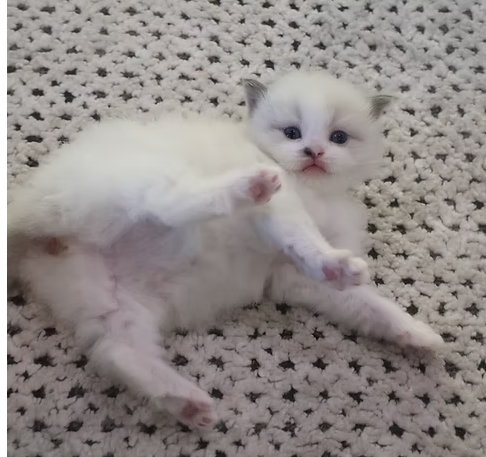
- White inverted V on the face — the signature feature. Starts between the eyes and fans outward. Should be clean and symmetrical on a well-marked cat. This is what sets the Bicolor completely apart from the Mitted pattern.
- White legs — the front and back legs are white from the paws up, typically reaching the body. Significantly more white than the Mitted’s paw-only markings.
- Broad white underbelly — wider than the narrow belly stripe of a Mitted. It creates a much higher percentage of white on the cat overall.
- Blue-gray on outer ears — the point color remains visible on the tips and backs of the ears, the outer face, back legs, and tail. It’s the color that frames and contrasts the white.
- Pink nose leather — one of the things people notice immediately. The pink nose surrounded by the white inverted V marking is part of what gives Blue Bicolor Ragdolls that open, soft facial expression.
What “Blue” Means and How the Color Develops in Blue Bicolor Ragdolls
In cat genetics, “blue” is the dilute version of black. The dilution gene spreads the black pigment out and softens it into a cool gray with a slight blue undertone. It’s not what most people think of when they hear “blue” — there’s nothing vivid or electric about it. It’s subtle, silvery, and soft. On a Bicolor cat where much of the face is white, that blue-gray shows up most strongly on the back of the ears and down the tail and hind legs.
Like all traditional Ragdolls, Blue Bicolor kittens are born completely white. The color doesn’t appear immediately. It starts to show up at the tips of the ears and on the back of the neck within the first week or two, and develops slowly from there. By 8 to 10 weeks the points are clear enough to see the full pattern, but the depth of the blue color continues developing well into adulthood — you won’t see the full richness of the point color until around 2 years of age.
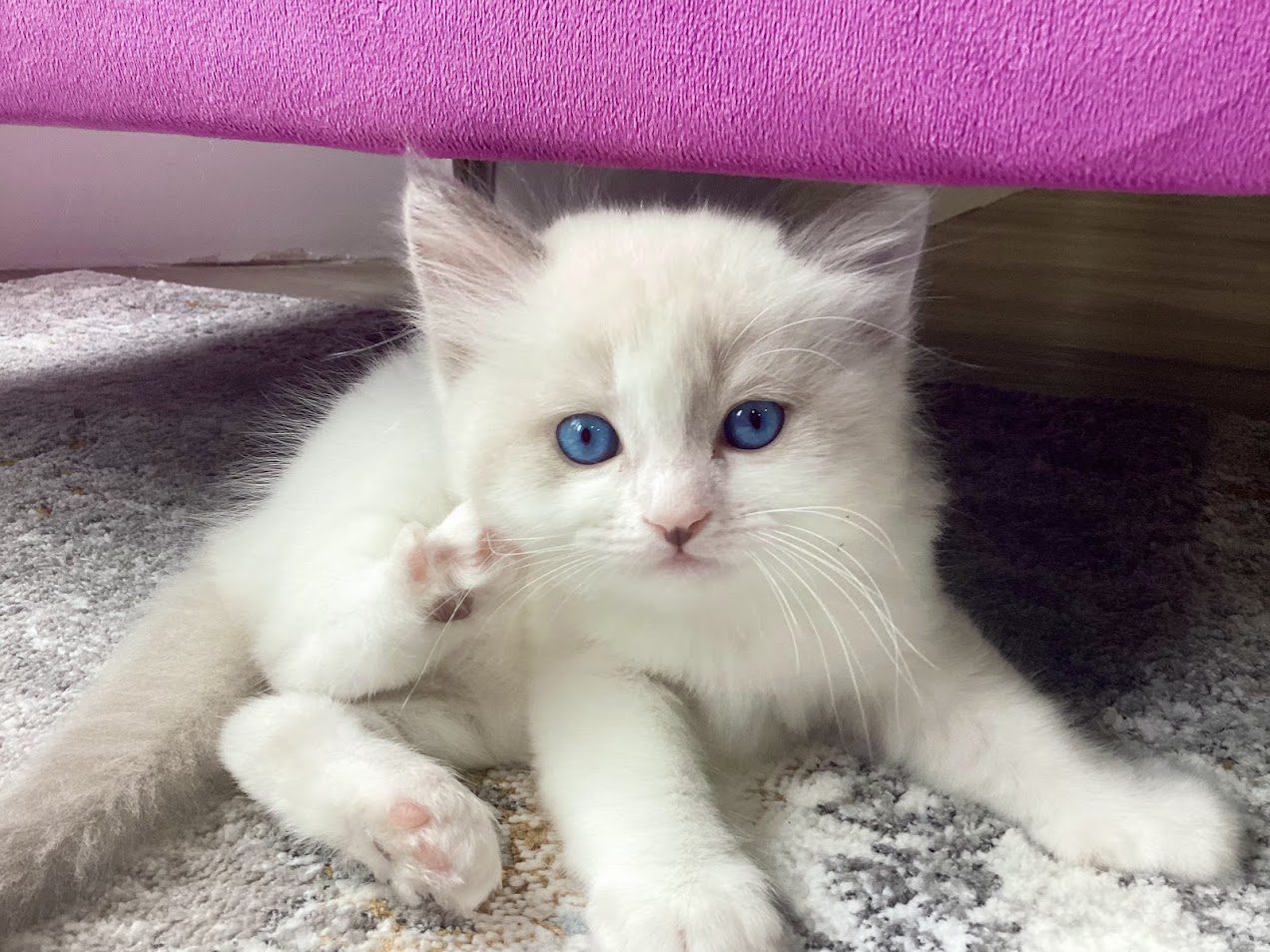

- Birth: Completely white. No visible points, no inverted V, nothing. Every traditional Ragdoll starts here.
- 1–2 weeks: Very faint blue-gray starts appearing at the ear tips. Easy to miss. The V hasn’t formed yet.
- 3–6 weeks: Point color becomes clearly visible on the ears. You can start to see where the inverted V will form on the face and how centered it is.
- 8–12 weeks: The full pattern is evident. The inverted V is well-defined, the white legs and belly are clear, and the blue-gray points on the ears and tail are visible. Eye color has shifted toward its adult blue tone.
- 1–2 years: Full adult color depth. The blue-gray deepens and settles. The contrast between the white and the points becomes more pronounced as the cat matures.
Eye Color in Blue Bicolor Ragdolls
Blue Bicolor Ragdolls always have blue eyes. That’s non-negotiable for traditional pointed Ragdolls — it’s part of the breed standard. If you’re seeing aqua or green eyes on a cat someone is calling a Blue Bicolor Ragdoll, they’re actually looking at a Mink Cherubim, not a traditional Ragdoll.
Within “blue” though, there’s a real range. The eyes can be a pale, almost silvery blue that shifts depending on the light. They can also come in a vivid, saturated sapphire that looks almost unreal against the white of the face marking. Both are correct and both occur in healthy, well-bred lines. In my experience, the eye intensity has a genetic component — parents with vivid blue eyes tend to produce kittens with stronger eye color.
The blue eyes set against all that white on the face is genuinely one of the most striking things about this pattern. It’s different from how blue eyes look on a Seal or even a Blue Mitted, because the inverted V frame gives so much more face-to-eye visibility.
Blue Bicolor vs. Blue Mitted — What’s the Difference?
I get this comparison constantly, especially from people who are new to Ragdolls and seeing both patterns for the first time. The color is the same — blue-gray points — but the white markings couldn’t be more different.
| Feature | Blue Bicolor Ragdoll | Blue Mitted Ragdoll |
|---|---|---|
| White on face | Bold inverted V covering most of the face | White chin only |
| White on front legs | White from paws up to the body | White paws only (the “mittens”) |
| White on belly | Broad white underbelly | Narrow belly stripe from chin to tail |
| White coverage overall | High — noticeably more white | Lower — more balanced color-to-white ratio |
| Overall impression | Bold, dramatic, high-contrast | Refined, subtle, elegant |
| Point color | Blue-gray on outer ears, back legs, tail | Blue-gray on all points |
| Eye color | Blue | Blue |
Neither is better — it’s completely personal preference. People who love the dramatic contrast tend to fall hard for the Bicolor. People who prefer a more balanced look usually go for the Mitted. I have full guides on both — see the Blue Mitted Ragdoll guide here if you want to compare them properly.
Blue Bicolor Ragdoll vs. Blue Mink Cherubim
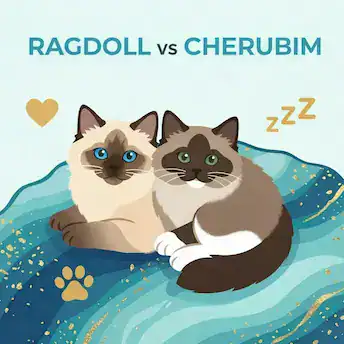
We breed both traditional Ragdolls and Mink Cherubim cats here at AquaMarine Kittens, so I can give you a real side-by-side answer on this rather than a textbook one. The Bicolor pattern is the same in both — inverted V, white legs, white belly. What changes is everything under the surface, at the genetic level.
| Feature | Blue Bicolor Ragdoll | Blue Mink Bicolor Cherubim |
|---|---|---|
| Born | White — color develops over weeks | Full color visible from birth |
| Eye color | Blue — always | Aqua or green |
| Coat texture | Silky, flowing semi-longhair | Dense, plush, velvety |
| Pattern | White inverted V, white legs, white belly | Same pattern, same placement |
| TICA classification | Ragdoll (traditional) | Cherubim (Ragdoll Breed Group) |
| Personality | Calm, affectionate, gentle | Calm, affectionate, gentle |
If you want to see how the Mink gene plays out in the Bicolor pattern specifically, the Seal Mink Bicolor Cherubim guide walks through it in full. You can also read the Ragdoll vs Cherubim comparison for the bigger picture on how these two classifications differ.
Personality and Temperament
The color and pattern are what bring people to the Blue Bicolor Ragdoll. The personality is what keeps them here — and keeps them coming back for a second one.
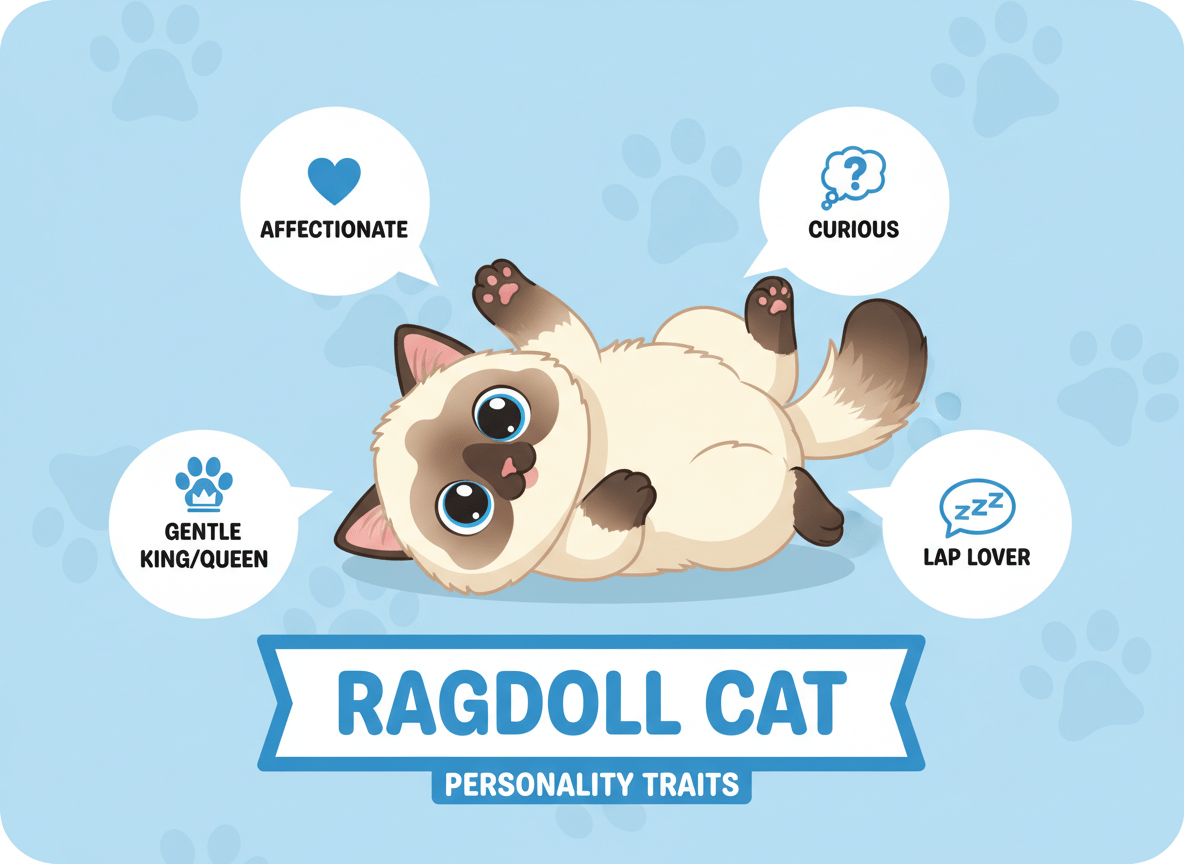
Ragdolls are genuinely calm in a way that’s different from other breeds. They don’t bolt. They don’t hide. When something new happens in the house, they check it out, decide it’s fine, and go back to what they were doing. They’re steady in a way that makes them incredibly easy to live with.
- They follow you room to room. Every single room. They want to be wherever you are. Not on top of you necessarily, but always nearby.
- They go completely floppy when held. The famous Ragdoll flop is real. They relax fully into your arms in a way other cats just don’t. Great for kids, great for anyone who wants a cat they can actually pick up and cuddle.
- They’re not demanding or vocal. They want your time but they’re quiet about it. No yelling, no pushing. They’ll just position themselves near you and be content.
- They stay playful as adults. Wand toys, feather toys, interactive games — adult Ragdolls still enjoy all of it. They don’t turn into furniture.
- They’re excellent with kids. Patient, gentle, and tolerant. Their calm temperament means they don’t lash out even when small children are less than perfect with them.
- They need company. These are not cats that handle long periods of being alone well. If you’re out of the house for long stretches regularly, seriously consider getting two.
Grooming and Care for Blue Bicolor Ragdolls
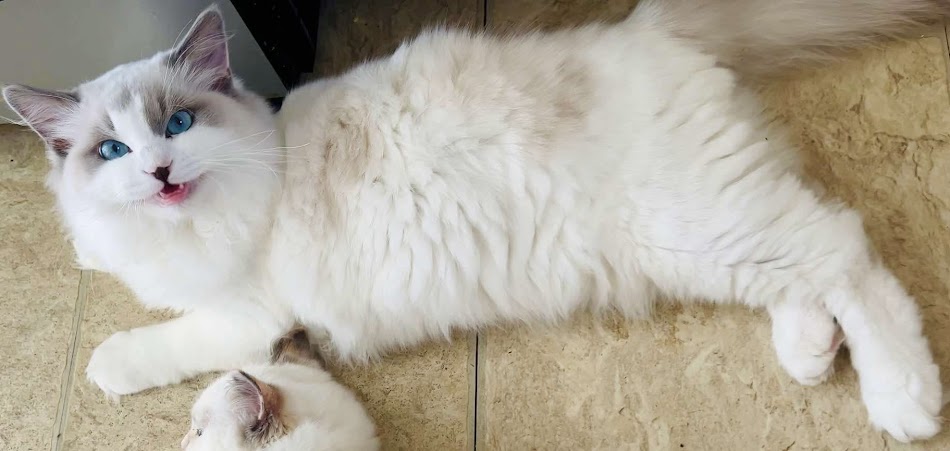
The Blue Bicolor Ragdoll’s semi-longhaired coat is silky and doesn’t mat as easily as some long-haired breeds, but it does need consistent brushing to look its best. The white areas in particular benefit from regular attention since any dullness in the coat shows up more clearly on white fur.
- Brushing two to three times a week keeps the coat healthy and tangle-free. During shedding season a bit more often. A slicker brush or wide-tooth comb works well on the Ragdoll coat type.
- Diet matters more than people think. All our kittens go home raw-fed and the difference in coat quality is real. High-quality raw or premium wet food keeps the coat bright and the whites looking clean. Read more in my raw feeding guide.
- Keep them indoors. Ragdolls are too trusting for outdoor life. Their calm nature means they don’t develop the street awareness that outdoor cats need to stay safe.
- Vet care and HCM screening. All our breeding cats are health-tested, including cardiac screening. Ragdolls can be predisposed to HCM — always ask a breeder about their health testing program before committing.
- Enrichment. Cat trees, window perches, wand toys. They’re curious and playful, especially as kittens, and they need things to explore.
From Our Cattery — AquaMarine Kittens
Watching a kitten like Shifu go from a tiny 5-week-old to a big, settled adult in his own home is genuinely one of the best parts of doing this. I still get updates from time to time, and it’s a good reminder of why I kept Blue Bicolors in the program in the first place.
Our Blue Bicolor Ragdolls — Bear, Mufi, Shifu, and More
Between Honey, Bear, Mufi, and Shifu above, you’ve already seen this pattern at nearly every stage — newborn-white, early development, mid-development, and full adult color. That progression from a plain white kitten to a fully marked Bicolor is honestly one of my favorite things to watch happen in a litter, every single time.
If you’re trying to evaluate a Bicolor kitten yourself, the short version is: look at the ears first (earliest color), then the face (where the V will settle), and don’t judge final depth of color until at least a year in — these cats keep developing long after they go home.
What the Pattern Looks Like in Motion
Photos are good for studying the markings, but the inverted V and the contrast read differently when the cat is moving — especially the way the white legs and blue-gray ears catch the light. These aren’t our cats, just general Blue Bicolor Ragdoll footage so you can see the pattern in motion.
Example Blue Bicolor Ragdoll — not an AquaMarine Kittens cat.
Example Blue Bicolor Ragdoll kitten — not an AquaMarine Kittens cat.
Frequently Asked Questions About Blue Bicolor Ragdolls
What is a Blue Bicolor Ragdoll?+
What makes the Bicolor pattern different from the Mitted pattern?+
Do Blue Bicolor Ragdolls have blue eyes?+
How does the inverted V marking work in a Blue Bicolor Ragdoll?+
When do Blue Bicolor Ragdolls get their full color?+
How is a Blue Bicolor Ragdoll different from a Blue Mitted Ragdoll?+
Is there a Blue Bicolor Ragdoll Cherubim?+
Final Thoughts
Blue Bicolor is the pattern I point to when someone asks what the most dramatic traditional Ragdoll looks like. The white inverted V, the cool blue-gray points, the blue eyes — it photographs well, but it’s even better in person. And underneath the markings is the same calm, people-focused personality every Ragdoll has.
If you’re considering a Blue Bicolor Ragdoll kitten and want to know what’s currently available or what litters are coming up, I’m always happy to talk. All of our kittens — Blue Bicolor, Mitted, or Mink Cherubim — are raw-fed, TICA-registered, and health-tested right here in Virginia.
Looking for Blue Bicolor Ragdoll Kittens?
Raw-fed, TICA-registered, health-tested, and raised in our Virginia home from birth. See what’s available or reach out about upcoming litters.
View Available Kittens