When Do Cherubim Cats Stop Growing? The Complete Guide to Their Size, Stages & Development
When do Cherubim cats stop growing? If you’ve just brought home a Cherubim kitten and watched it sprawl across half your couch, you’re probably wondering exactly that. The answer is: later than you think. Cherubim cats are one of the slowest-growing and largest domestic cat breeds — and understanding their full development timeline changes how you see every stage of their life.
Table of Contents
When Do Cherubim Cats Stop Growing? The Short Answer
Cherubim cats generally stop growing at an age between three and four years. Some Cherubim males, particularly larger ones, continue to fill out and increase their muscle mass up until their fourth year and sometimes even beyond. When do Cherubim cats stop growing completely? For most, that answer lands squarely at four years old.
Cherubim cats are unique among domestic cats in this regard. The average domestic cat is physically fully grown by their first year. Larger breeds like the Maine Coon are fully grown by their second year. Cherubim cats reliably fall in the three- to four-year bracket, making them one of the longest-developing breeds you can own.
It’s worth making a distinction between two types of growth: linear growth — getting taller and longer — and developmental growth — getting filled out, stronger, and heavier. Cherubim cats appear to have completed their linear growth by as early as eighteen months to two years. They continue to fill out, get heavier, and get stronger for years afterward. The answer to when do Cherubim cats stop growing is different depending on what kind of growing you’re talking about. The fully grown version of your Cherubim cat can take many years to arrive.
When they do arrive, they are exceptional.
Why Cherubim Cats Take So Long to Fully Grow
The Cherubim cat’s long development period is a function of their size. Larger body masses take longer to develop than smaller ones — this is true across nearly every species. The same biological principle that controls Great Dane development versus Chihuahua development applies to domestic cats. The size of an animal determines how long it needs to develop in order to be fully grown.
Cherubim cats are placed in the Ragdoll Breed Group by TICA (The International Cat Association) and share the large, muscular body type of the Ragdoll — broad chest, heavy bone structure, and substantial mass. These traits simply take longer to develop than those of a smaller breed. A mature, adult male Cherubim cat can weigh anywhere from 15 to 25 lbs, and that is real muscle and bone, not just coat. The skeletal system, the muscles, and the hormonal systems that control everything in the body just need more time than a cat designed to weigh 8 lbs.
There is also a genetic factor specific to this type. The Cherubim’s foundation — the Ragdoll breed — was created specifically to be a large, companion-oriented cat. That genetic makeup for a big, plush, substantial animal also comes with a longer development timeline than smaller breeds.
This is very helpful to know as a new Cherubim owner. If your six-month-old Cherubim is nothing like the big, plush adult you saw in photos, don’t worry. They’ll get there. It’s just a longer road than most people expect the first time they ask when do Cherubim cats stop growing.
Cherubim Cat Growth Stages: From Birth to Full Maturity
Here is a detailed breakdown of each growth stage in a Cherubim cat, from birth through full maturity. Understanding each stage helps answer when do Cherubim cats stop growing — and what to expect along the way.
Newborn (0–2 Weeks)
Cherubim kittens are born small, with a birth weight of between 3 and 4.5 oz. One of the most immediately distinctive things about Cherubim kittens — compared to traditional Ragdolls — is that Mink and Sepia Cherubim kittens are born with their color already fully visible. Traditional Ragdolls are born white and develop color over weeks. Cherubim kittens show you their color from day one.
At this stage the kittens are completely dependent on the mother. Eyes and ears are closed, they cannot regulate their own body temperature, and all they do is nurse, sleep, and grow. A healthy Cherubim kitten should roughly double its birth weight in the first two weeks.
Early Development (2–4 Weeks)
Eyes open between days nine and fourteen. Ears begin to function during this period. The kittens take their first clumsy steps and baby teeth begin to appear. Socialization starts here — kittens begin interacting with each other and becoming aware of the people around them. Handling during this phase starts shaping the confident personalities Cherubim cats are known for.
Weaning and Socialization (4–8 Weeks)
This is one of the most important phases. Kittens begin transitioning to solid food alongside the mother’s milk, starting with wet food introduced gently. Physically, growth is rapid and visible — the kitten is beginning to look like a cat. In Cherubim kittens, the Mink or Sepia color becomes richer and deeper as they develop.
Socialization during this window is critical. Kittens handled regularly and exposed to normal household activity become confident adult cats. At AquaMarine Kittens, our kittens live in the middle of our home from this point — people, noise, activity. We take this period very seriously.
Active Kitten Phase (8–16 Weeks)
Most Cherubim kittens go to their new homes during this period — typically between twelve and sixteen weeks. Responsible breeders wait at least twelve weeks before sending kittens home. This is a period of rapid, visible growth. The kitten is energetic, curious, and burning through energy at a rate it will never repeat. Physically it is growing fast and becoming noticeably larger than the average kitten at the same age. The plush, dense Mink coat is becoming more apparent.
Nutrition is especially important now. A high-protein diet supports the rapid muscle and bone development happening in this window. This is part of why we raw-feed our kittens from the time they start eating solids — the results are visible in every litter.
Adolescence (4–12 Months)
This is where Cherubim cat growth often surprises new owners. Between four and twelve months, Cherubim cats go through a noticeable growth spurt in height, length, and weight. You’ll probably be buying larger food portions and reconsidering whether that cat tree is tall enough.
Behaviorally, the young Cherubim at this stage is playful and energetic but beginning to show the calmer adult temperament underneath. It’s not uncommon for Cherubim kittens to go through a slightly awkward “lanky” phase as limbs and body grow faster than mass fills in — completely normal and temporary.
At twelve months, Cherubim cats look like adults. Many owners assume development is done. It isn’t — not by a long way.
Young Adult Continued Development (1–2 Years)
Growth continues but at a slower rate. This is when the “filling out” really begins — the chest widens, the neck thickens, and the muscles start giving the cat its substantial adult presence. The plush Mink or Sepia coat also reaches its full development during this period; don’t expect the full coat until eighteen to twenty-four months.
Full Maturity — When Cherubim Cats Stop Growing (2–4 Years)
This is the final stretch and the direct answer to when do Cherubim cats stop growing. The body finishes developing its mass, muscle density, and chest breadth. Male Cherubim cats in particular can continue to surprise their owners during this period — a cat that already seemed large will keep broadening and filling out, adding a level of substance that’s hard to describe until you’ve seen it in person. By the end of this period, a fully mature male Cherubim is a genuinely impressive cat.
Females tend to reach full size a little earlier — around two and a half to three years — and carry slightly less mass than males.
Cherubim Cat Weight by Age — What to Expect
These weights are approximate. Individual variation occurs based on genetics, sex, and nutrition. Our raw-fed Cherubim kittens tend to run at the higher end of these ranges.
Cherubim Cat Weight Chart (in lbs)
- Birth 0.2 – 0.28 lbs (3–4.5 oz)
- 2 weeks 0.4 – 0.55 lbs
- 4 weeks 0.66 – 1 lb
- 8 weeks 1.5 – 2.2 lbs
- 12 weeks 2.2 – 3.3 lbs
- 4 months 3.3 – 5.5 lbs
- 6 months 4.4 – 7.7 lbs
- 9 months 6.6 – 11 lbs
- 12 months 8 – 12 lbs (female) | 10 – 14 lbs (male)
- 18 months 9 – 13 lbs (female) | 12 – 17 lbs (male)
- 2 years 10 – 14 lbs (female) | 13 – 20 lbs (male)
- Full maturity (3–4 years) 10 – 14 lbs (female) | 15 – 25 lbs (male)
A note on these numbers: Cherubim cat weight is genuinely variable and greatly dependent on genetics, nutrition, and spayed/neutered status. A well-muscled male Cherubim on a raw diet is NOT overweight. He’s built that way. The goal is lean, healthy muscle — not a number on a scale.
Male vs. Female Cherubim Cat Growth Differences
The size differences between male and female Cherubim cats are much greater than in many other breeds. Understanding this helps set realistic expectations as your Cherubim grows.
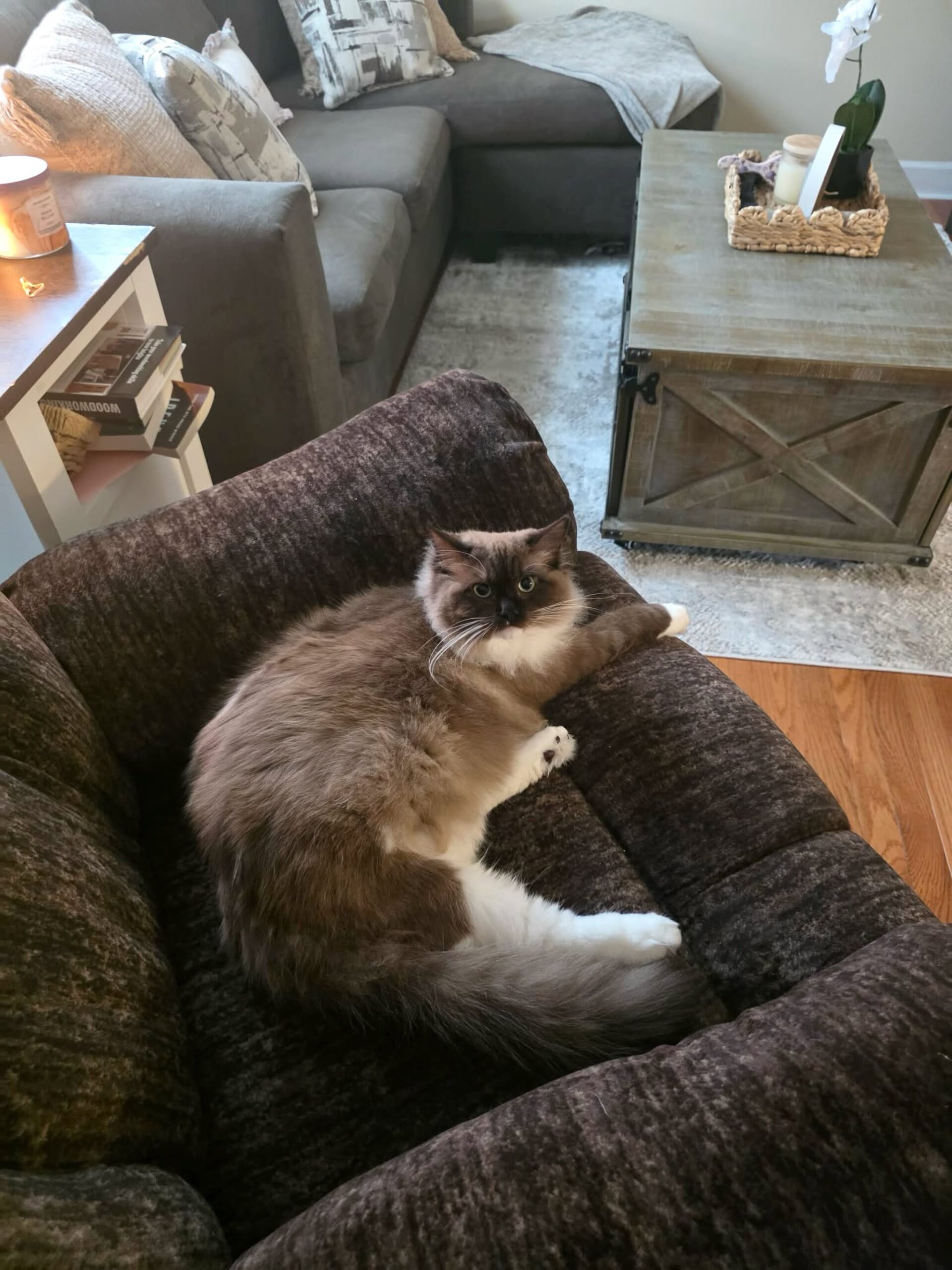
Males will grow larger, heavier, and continue to develop for a much longer period — typically three and a half to four years, sometimes longer. The final mass of a mature male is considerably heavier than a female of the same lineage. Males also develop a wider, rounder face with a softer expression, a heavier neck, and a broader chest.
Females finish growing a bit earlier — around two and a half to three years — and are lighter and less massive than males. They’re still large cats by any standard, but the difference between a fully grown male and female Cherubim is noticeable. Both have the same temperament, Mink coat quality, and overall build. The differences are purely physical.
For families who want a slightly smaller Cherubim, a female is generally the better choice. For families who want maximum presence — that big, floppy, substantial cat experience — a male delivers it more completely. You can read more about the personality side of this in our Male vs. Female Ragdoll guide.
What Affects How Big Your Cherubim Cat Will Get
Several factors influence the final size of your Cherubim cat. Understanding them helps manage expectations and gives you the tools to support healthy development.
Key Factors That Influence Cherubim Cat Size
- Genetics and Lineage — The single biggest factor. If the breeding cats are large, well-built animals, the kittens will follow. We’re always happy to share the weights of our breeding cats and how their previous litters have developed.
- Sex — Males grow significantly larger than females. This is one of the more predictable variables if size matters to you.
- Nutrition During Development — Hugely underestimated. A Cherubim kitten on a nutritionally complete, high-protein diet will develop more fully than one on a poor-quality diet. This is why we raw-feed from the time kittens are weaned. The difference in muscle development, coat quality, and overall condition is obvious in every litter. Our six-month-old kittens typically average around 10 lbs.
- Spay and Neuter Timing — Early spay or neuter results in slightly taller, leaner cats due to the effect on growth plates. Later neutering results in slightly broader and heavier cats. The difference is real but moderate. All our kittens go home altered or with a spay/neuter requirement.
- Overall Health — Illness, parasites, or nutritional problems during development can limit a Cherubim’s growth. Good veterinary care, anti-parasite treatment, and quality food during the first two years are essential.
- Environment and Stress Levels — Chronic stress during the development period has a proven effect on a cat’s growth. A calm household, proper socialization, and stable environment during the early months supports better development outcomes.
Signs Your Cherubim Cat Has Stopped Growing
Given how gradual the Cherubim cat’s development is, it can be hard to tell exactly when do Cherubim cats stop growing. These signs indicate your cat has reached full maturity:
- Weight stabilization. When your Cherubim cat’s weight has remained consistent for three or more months with no changes to their diet, active growth is most likely complete. They may continue to develop subtle muscle density, but the visible growth has stopped.
- Chest and shoulder width settled. In males especially, the chest and shoulder area is the last thing to fully develop. When this area feels stable and no longer seems to be changing month to month, growth is essentially done.
- Face fully rounded. A mature Cherubim cat has a wide, rounded face with full cheeks. When the face looks fully developed and the jowls have filled in — that’s the adult expression.
- Coat fully developed. The Mink or Sepia coat of a fully mature Cherubim is dense, plush, and uniform. When it looks complete and consistent from month to month, physical development is at or near the end.
Nutrition and Its Role in Cherubim Cat Growth
Any discussion of when Cherubim cats stop growing needs to address nutrition, because it plays a major role in the adult cat your Cherubim becomes. According to the Cornell Feline Health Center, cats are obligate carnivores whose bodies are designed to process animal protein efficiently — and that need is at its highest during the growth years.
A high concentration of animal protein provides the building blocks for muscle, bone, coat, and immune system development — all of which are still happening well into the Cherubim cat’s third and fourth year. What you feed during this window matters more than most people realize.
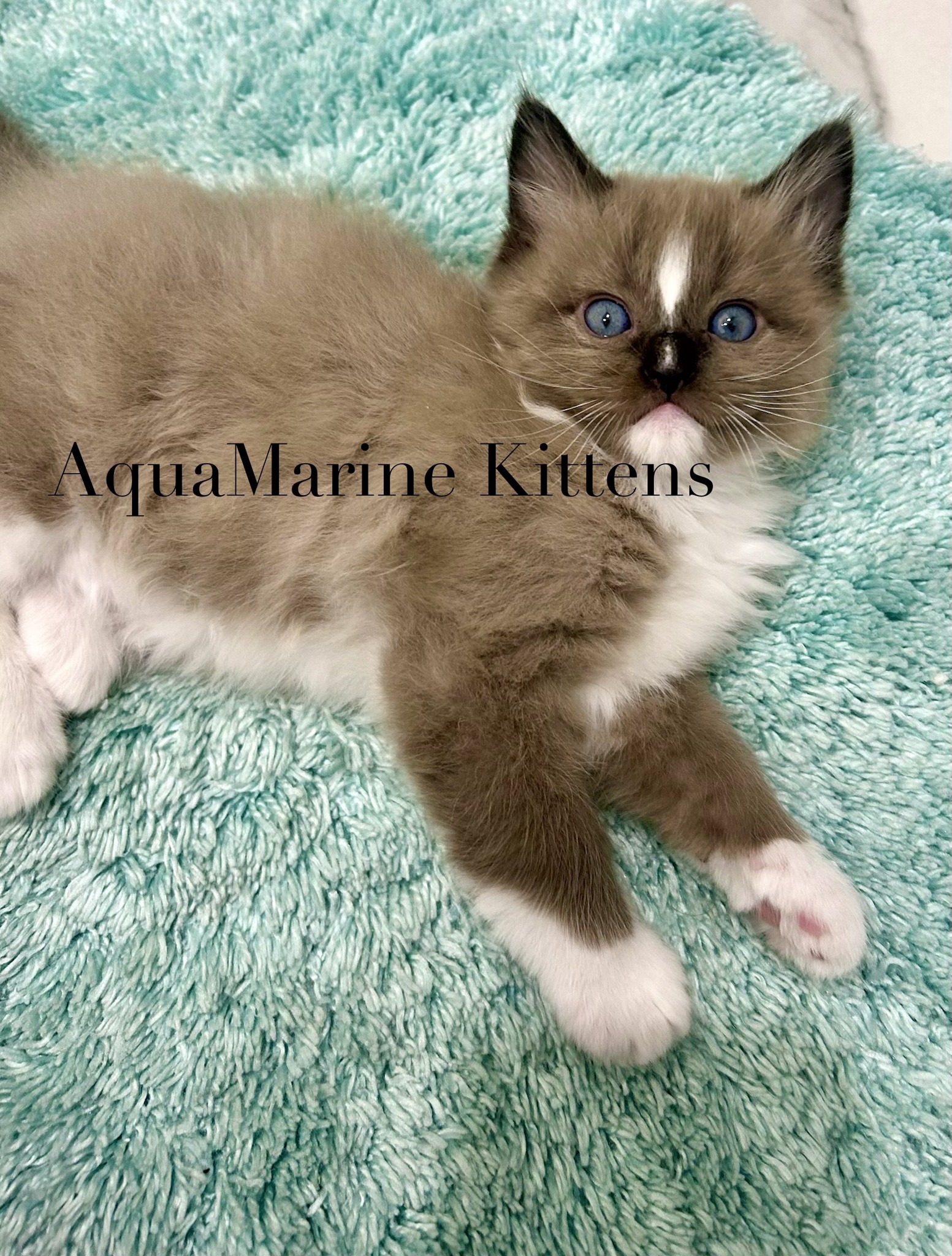
Raw feeding is what we use at AquaMarine Kittens, and the results speak for themselves. Our breeding cats are in better body condition than when we used premium kibble. Our queens recover faster from weaning, and our kittens grow stronger and more robust. If raw feeding isn’t feasible for your situation, a high-quality wet food with a named meat as the first ingredient and no grains or fillers is the next best option. Dry-food-only is the least suitable choice for a growing Cherubim, primarily due to moisture content and carbohydrate levels.
For more on what we feed and why, see our guide: 7 Positive Reasons — Can Cats Eat Raw Meat?
Common Cherubim Cat Growth Questions Answered
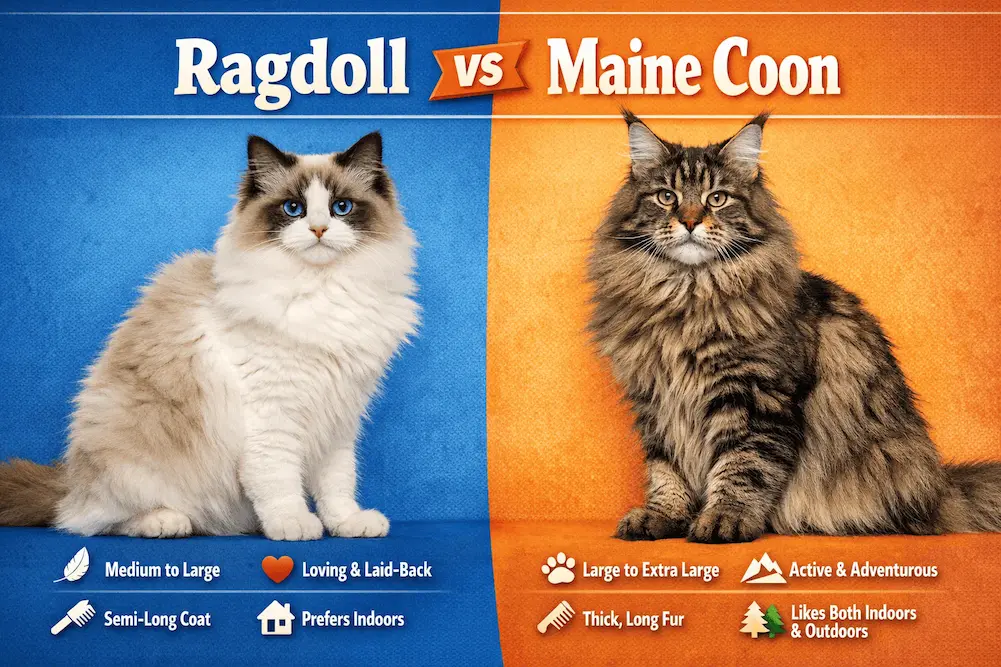
Ragdoll and Cherubim cat growth and development — a good visual companion to this guide. Note: not our cats.
Frequently Asked Questions About When Cherubim Cats Stop Growing
Final Thoughts on When Cherubim Cats Stop Growing
When do Cherubim cats stop growing? Later than you might expect — which is actually one of the joys of owning one. You get to watch something slowly come into its own. A tiny, dark-from-birth newborn. A bouncy, curious kitten. A lanky adolescent. A substantial young adult. And then, somewhere around year three or four, the finished cat — plush, heavy, calm, and exactly what you hoped for when you first saw that kitten photo.
Tom at 13 lbs and 8 months old is not done. Myla at 12 lbs and 8 months is not done. Jerry at 20 lbs and a year and a half is still not done. The process is long, the payoff is real, and the patience required is minimal when you know what to expect.
If you’re caring for a Cherubim kitten and wondering when the growing will stop — relax, feed them well, and enjoy each stage. The final version of your cat is on the way.
Our Cherubim and Ragdoll kittens are raised in a real family home — health-tested, raw-fed, and socialized from birth. Come see who’s available.
Meet Our Available Kittens