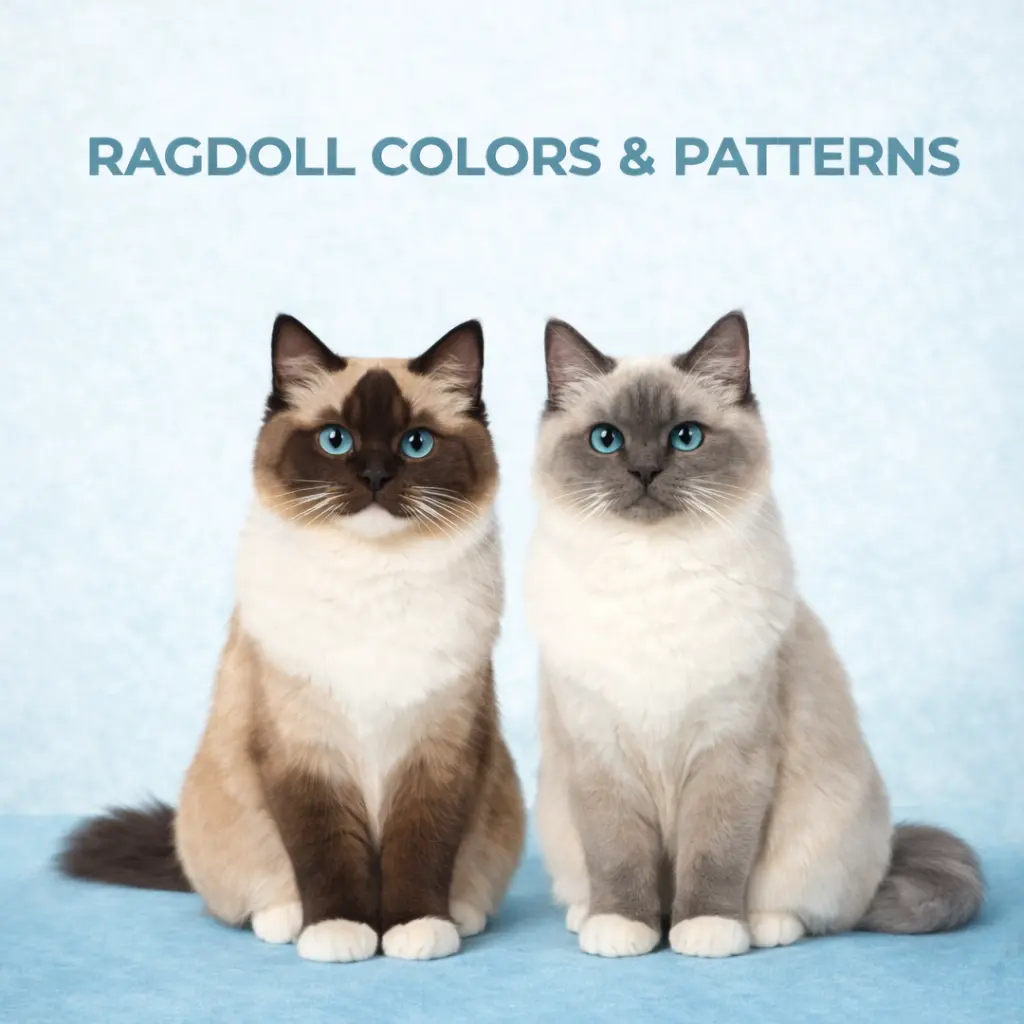
The Blue Mitted Ragdoll is the kind of cat that makes people stop and look twice. Not because it’s flashy — because it’s soft. That cool blue-gray color against white mittens and blue eyes has a quality to it that’s hard to describe until you see it in person. I’ve raised them, and every time a litter of blue kittens starts to reveal their points, I’m still surprised by how beautiful it is.
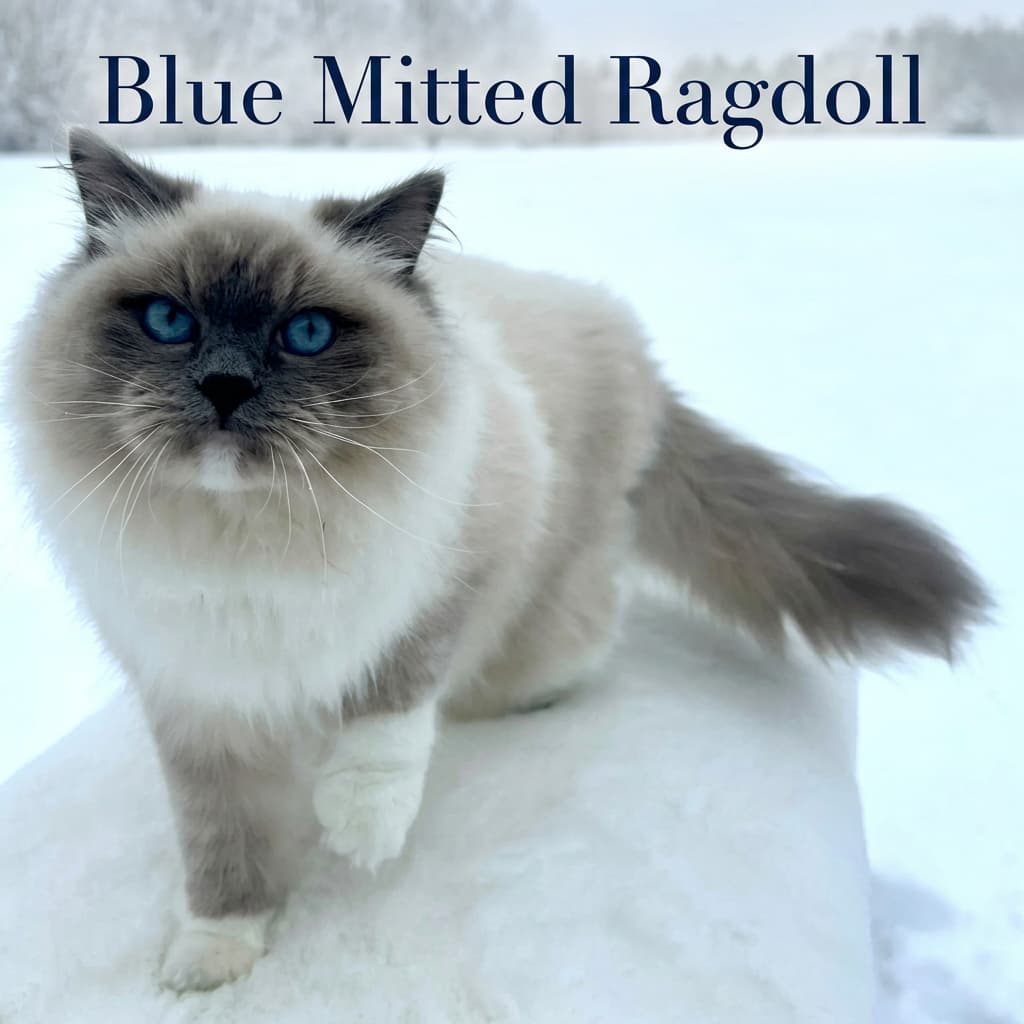
Table of Contents
What Is a Blue Mitted Ragdoll?
A Blue Mitted Ragdoll is a traditional pointed Ragdoll with blue-gray color on the points — the ears, face, legs, and tail — white “mittens” on the paws, a white chin, and a white belly stripe. The body is a soft cream or off-white. The eyes are always blue.
It’s a complete look, and every part of it works together. The cool blue-gray of the points doesn’t compete with the white markings — it complements them. The result is something that feels more elegant and understated than the Seal, and people who love the Blue Mitted tend to feel very strongly about it.
Blue Mitted Ragdolls are fully recognized by TICA (The International Cat Association) as part of the traditional pointed Ragdoll breed standard. They’re not rare — they’re one of the more commonly bred traditional colors — but finding one from a health-tested, reputable cattery still requires some searching.
What “Blue” Actually Means in a Ragdoll
This is the question I get more than almost any other when people are new to Ragdolls. What exactly is “blue”? Because looking at a Blue Mitted Ragdoll, you don’t see what most people would call blue — you see a cool, silvery gray.
In cat genetics, “blue” is the dilute form of black. The dilution gene takes the full black pigment and spreads it out, creating a softer, lighter version of the color — that cool gray with a slight blue undertone. It’s the same thing that happens with “lilac” (dilute chocolate) and “cream” (dilute red). So when you see “blue” on a Ragdoll, you’re really seeing diluted black — and the result on a pointed cat is that beautiful, almost smoky gray-blue tone on the ears, face, legs, and tail.
One thing worth knowing about blue points: like seal, there’s variation in how deep and rich the blue-gray comes in. Some Blue Mitted Ragdolls develop quite dark, almost charcoal-gray points. Others stay in a lighter, frostier blue-gray. It comes down to individual genetics, and you can often see the difference clearly even between siblings from the same litter.
Do Blue Mitted Ragdolls Have Blue Eyes?
Yes — always. Blue eyes are a requirement of the TICA breed standard for traditional pointed Ragdolls, and the Blue Mitted is no exception. There’s no version of a traditional Blue Point Mitted Ragdoll cat with green or aqua eyes. If you’re seeing those eye colors, you’re looking at a Mink Cherubim, not a traditional Ragdoll.
That said, “blue” again covers a range. The eyes can be a pale, almost silvery blue that almost looks gray in certain light. They can also be a deep, saturated sapphire. Both are correct, and both occur within the traditional breed. I’ve had litters where one kitten ends up with very pale eyes and the sibling has vivid, vivid blue. Same parents, noticeable difference.
- Always blue — no exceptions for traditional pointed Ragdolls. If the eyes are aqua or green, that’s a Mink Cherubim, not a traditional Ragdoll.
- Range from pale to vivid — some individuals develop a light, almost gray-blue. Others reach a deep sapphire. Both are within the breed standard.
- Deepens with age — the eye color usually becomes more defined between 8 and 16 weeks. Newborn eyes start as a flat gray-blue and clarify over time.
- Genetics play a role — if both parents have vivid eyes, kittens tend to inherit deeper color. Asking to see the parents is always a reasonable thing to do when choosing a kitten.
Born White: How the Color Comes In
Every traditional Ragdoll — Blue Mitted included — is born completely white. No hint of blue, no visible mittens, nothing. Just a fluffy white newborn. It surprises people every time, especially people who were expecting to see the color immediately.
The blue-gray starts appearing on the coolest parts of the body first — the tips of the ears, the nose, the paws. It’s the same temperature-sensitive pigmentation mechanism you see in Siamese cats. The color develops in the points because those areas are coolest, and the gene that controls color expression responds to temperature.
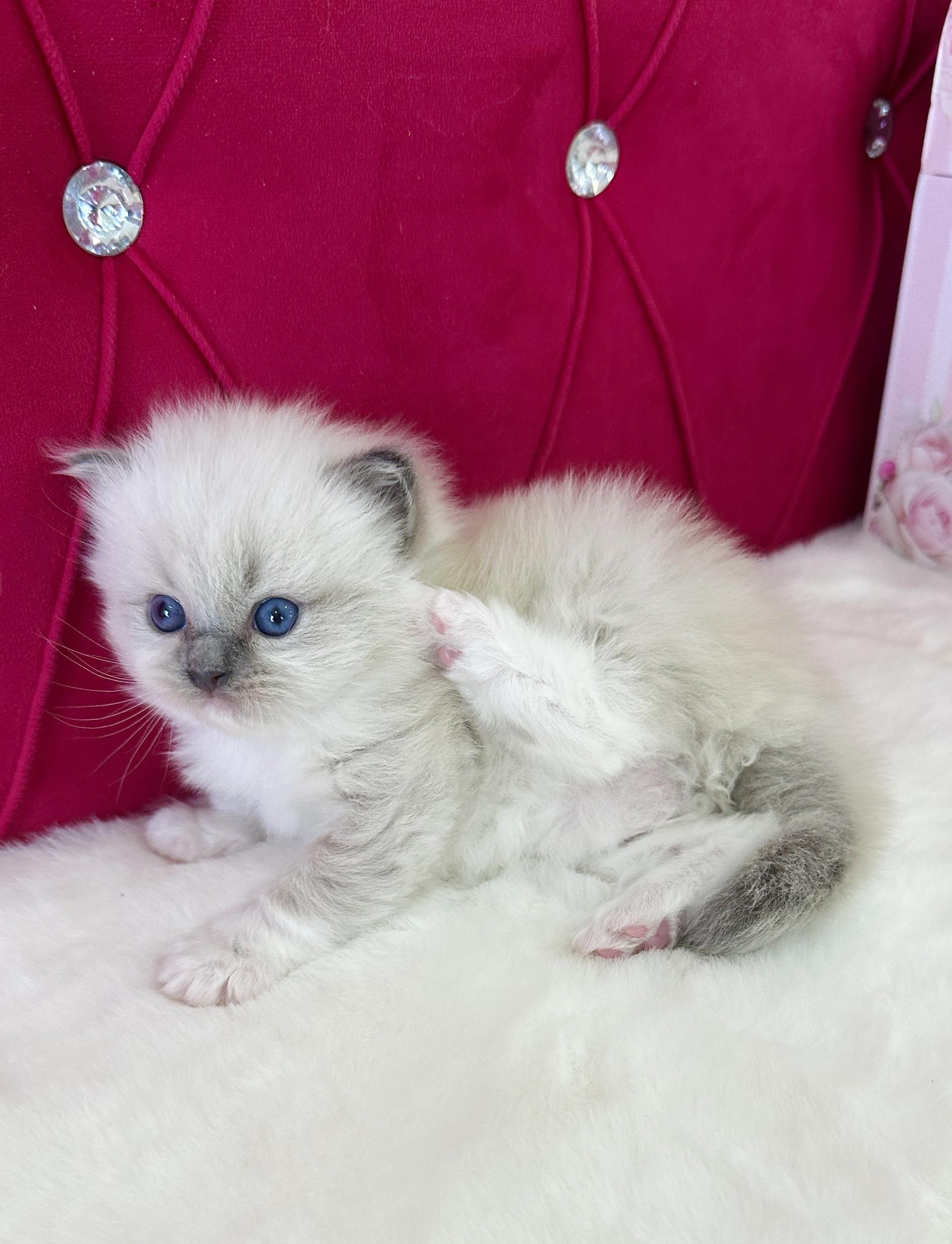
- Birth to 1 week: Completely white. No blue color, no visible mittens. Just a fluffy newborn.
- 1–3 weeks: Very faint shading starts at the tips of the ears and along the nose leather. Easy to miss if you’re not looking for it.
- 3–6 weeks: Blue-gray color becomes clearly visible on the points. The mitted markings — white paws, white chin, belly stripe — become well-defined. Eyes shift from flat gray-blue toward their adult tone.
- 6–16 weeks: Color deepens noticeably. By 10–12 weeks the full pattern is clear and the eye color is close to what it will be as an adult.
- 1–2 years: Full adult color depth. Blue points continue to settle and deepen slightly, and the contrast with the cream body becomes more pronounced.

The Mitted Pattern — What to Look For
The “mitted” part of the name refers to a specific set of white markings that are distinct from the Bicolor pattern. It’s a more subtle pattern than Bicolor — less total white, more balanced — and on a Blue point the contrast is elegant rather than dramatic.
- White front paws — the defining feature. Should be evenly white on both paws, ideally matching. This is where the “mitted” name comes from.
- White chin — a clean white patch under the chin that flows into the belly stripe.
- White belly stripe — runs from the chin to the base of the tail. Width varies by individual — some cats have a narrow stripe, others broader.
- White hind legs — the back legs are white from the paws up, typically to mid-leg or higher. Distinct from Bicolor where white extends further up the leg.
- Optional blaze — some Blue Mitted cats have a white stripe between the eyes on the nose. Not required for breed standard but appears in some lines.
One thing that catches people off guard is what a “mismarked” Mitted looks like. In a litter, you can occasionally get a kitten where the white markings are asymmetrical — one mitt cleaner than the other, or the belly stripe going off-center. Those cats are still wonderful, just not show-quality. I’ll show you what that looks like in the litter photo below.
Blue Mitted vs. Seal Mitted Ragdoll
This is the most common comparison I get asked about because they’re such similar cats in every way except the point color. If you’re deciding between the two, this table makes the difference clear.
| Feature | Blue Mitted Ragdoll | Seal Mitted Ragdoll |
|---|---|---|
| Point color | Cool blue-gray | Rich dark chocolate-brown |
| Body color | Off-white to pale cream | Cream — sometimes slightly warmer |
| White markings | Paws, chin, belly stripe | Paws, chin, belly stripe |
| Eye color | Blue — pale to sapphire | Blue — pale to sapphire |
| Overall impression | Soft, elegant, understated | Bold, rich, high-contrast |
| Color depth variation | Lighter to darker blue-gray | Lighter to darker chocolate |
| TICA recognition | Yes — traditional pointed | Yes — traditional pointed |
Neither is better — they’re just different. People who gravitate toward Blue Mitted tend to love the softness of it. People who want strong contrast tend to prefer Seal. I love both, and we breed both at AquaMarine Kittens. You can see our full guide to the Seal Mitted Ragdoll here if you want to compare side by side.
Blue Mitted Ragdoll vs. Blue Mink Mitted Cherubim
We also breed the Blue Mink Mitted Cherubim here, and I get asked about this comparison constantly — because the names are so similar that it’s genuinely confusing if you’re new to Ragdolls and Cherubims. The mitted pattern is the same. The genetics underneath are different, and those genetics change three things.
| Feature | Blue Mitted Ragdoll | Blue Mink Mitted Cherubim |
|---|---|---|
| Born | White — color develops over weeks | Full color visible from birth |
| Eye color | Blue | Aqua or green |
| Coat texture | Silky, flowing semi-longhair | Dense, plush, velvety |
| Color at birth | None visible | Blue-gray already showing |
| TICA classification | Ragdoll (traditional) | Cherubim (Ragdoll Breed Group) |
| Personality | Calm, affectionate, gentle | Calm, affectionate, gentle |
The temperament is essentially the same across both. If you want to go deeper on the Cherubim side, I have a full guide on the Blue Mink Mitted Cherubim here. And if you’re curious how the Mink gene plays out in other patterns, the Seal Mink Mitted Cherubim and Seal Mink Bicolor Cherubim posts cover those in full. There’s also a full breakdown in Ragdoll vs Cherubim: 4 Key Differences if you want the big picture.
Personality and Temperament
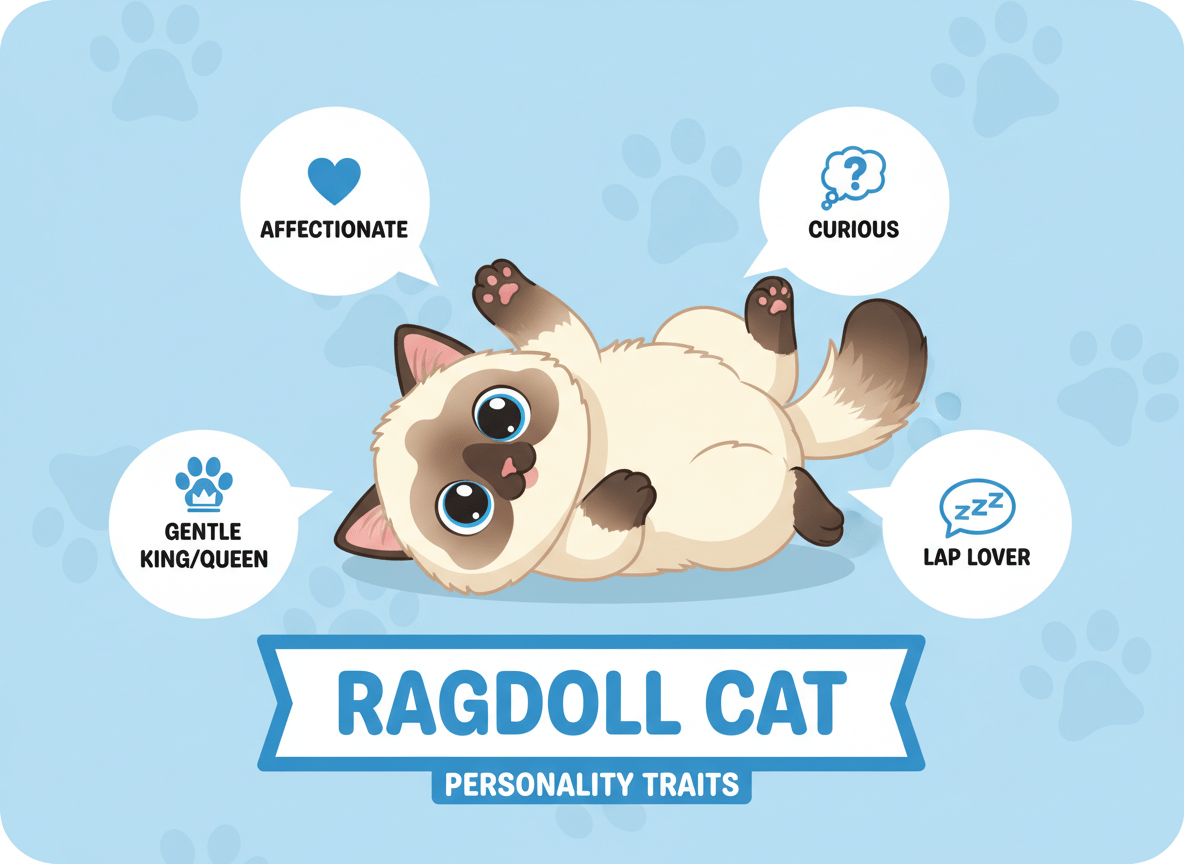
Color doesn’t change personality in Ragdolls. What you get with a Blue Mitted Ragdoll — or any traditional Ragdoll — is one of the most people-oriented cat personalities you’re going to find in any breed. They’re calm in a way that stands out even compared to other calm breeds. They don’t startle easily. They don’t bolt when something changes. They check it out and go back to what they were doing.
The “floppy” reputation is real. Pick up a Ragdoll and they genuinely relax in your arms in a way that other cats don’t. It’s one of the things that makes them so easy with children and so popular with families who’ve never had a cat before.
- They follow you everywhere. Room to room, bathroom door, kitchen floor — wherever you are is where they want to be.
- They go limp when held. The famous Ragdoll flop is very real. They relax into your arms fully, which makes them incredibly easy to handle and great with kids of all ages.
- They’re not demanding. They want your company, but they’re quiet about it. No yelling, no constantly pawing at you. They’ll just find a spot nearby and be content.
- They stay playful. Adult Blue Mitted Ragdolls still enjoy wand toys, feather toys, and games. The playfulness doesn’t disappear when they grow up.
- They need company. These are not cats that do well being left alone for long periods. If you work long hours regularly, consider getting two so they have each other.
- They’re gentle with kids and other pets. Patient, calm, and tolerant. They don’t usually lash out, even when kids are less than graceful with them.
Grooming and Care
The Blue Mitted Ragdoll has a semi-longhaired coat that’s silky and soft. It doesn’t mat as badly as some other long-haired breeds, but it does need regular brushing to stay looking its best and to prevent any tangles from forming, especially behind the ears and under the armpits.
- Brushing: Two to three times per week keeps the coat healthy and tangle-free. More frequently during shedding season in spring and fall. A slicker brush or wide-tooth comb works well on the Ragdoll coat.
- Diet: All of our kittens go home raw-fed, and the difference it makes in coat quality is visible. A high-quality raw or premium wet food diet keeps the coat silky and bright. Read more in my raw feeding guide.
- Enrichment: Cat trees, window perches, wand toys. They’re curious and playful — they need things to explore and climb.
- Vet care: Regular wellness visits, vaccinations, and cardiac screening for HCM. All of our breeding cats are health-tested and kittens go home with a health guarantee.
- Indoor only: Ragdolls are too trusting for outdoor life. Their calm nature makes them vulnerable — they don’t have the street instincts that street cats develop. Keep them inside or in a safely enclosed space.
Meet Twinkle and Pringle — Our Blue Mitted Ragdolls
Twinkle and Pringle are siblings — brother and sister from the same litter — and they’re the cats I always point to when someone asks me what a Blue Mitted Ragdoll looks like at different ages. Watching them go from tiny white newborns to fully colored, beautiful adults has been one of the most rewarding things about this breeding program.

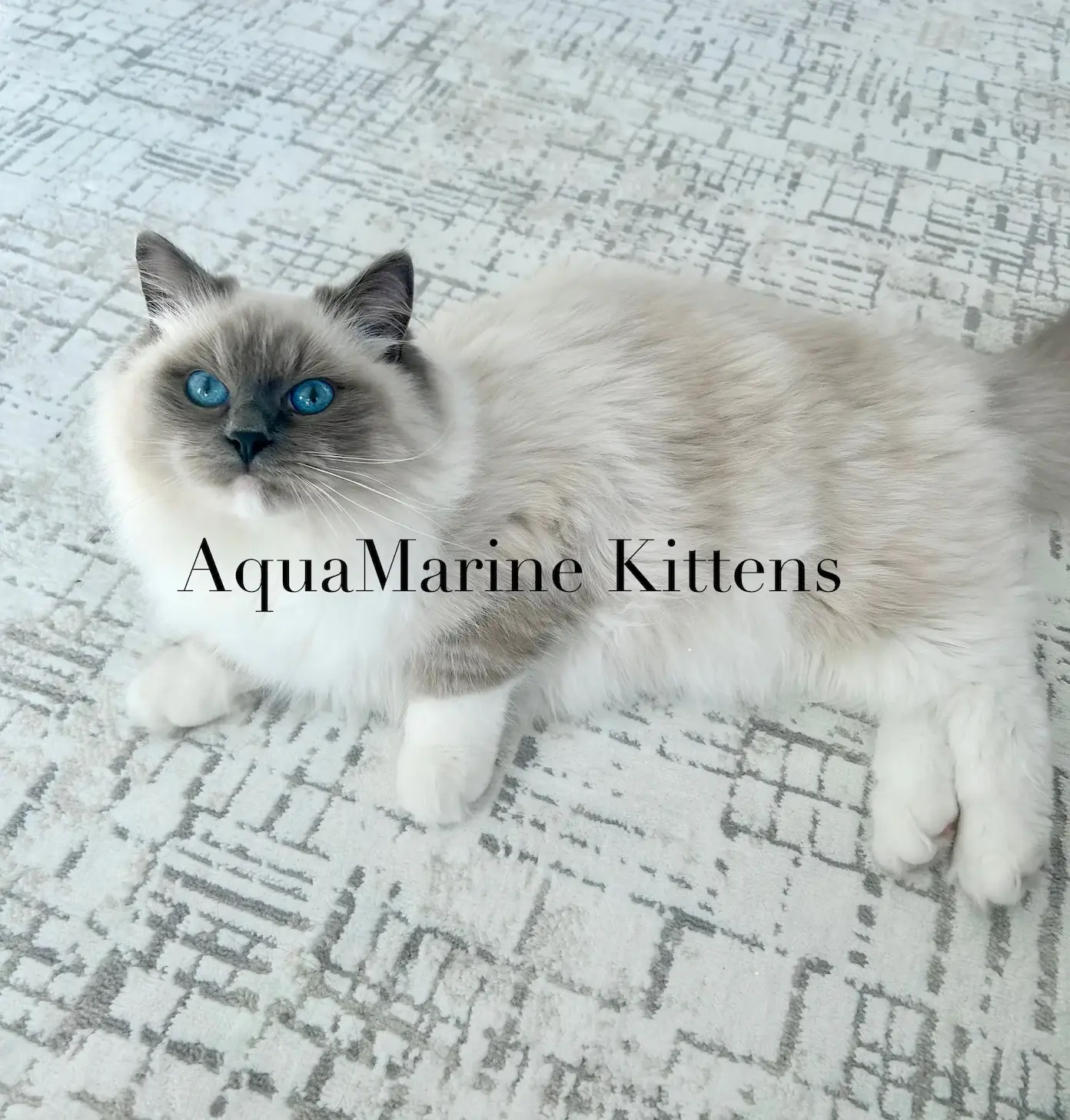
The difference between Pringle at 8 weeks and Twinkle at 11 months shows you exactly how the color continues to develop and deepen. At 8 weeks the points are clear but still on the lighter side. By 11 months, the blue-gray has settled into something richer and more defined. And it doesn’t stop there — it keeps deepening through to about 2 years of age.
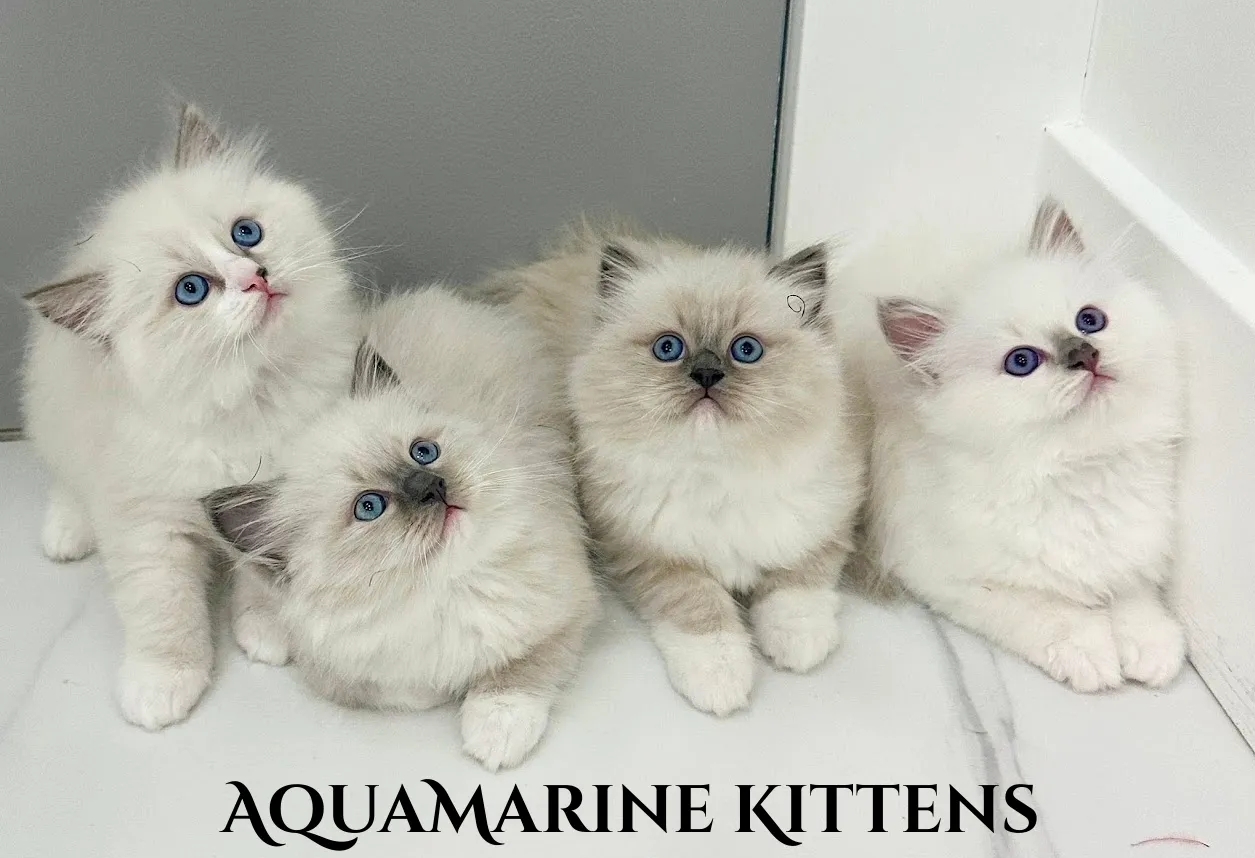
From Our Cattery — AquaMarine Kittens
That litter photo is one of my favorites because it shows you real variation in a real litter — including the Lilac on the right (a completely different color), the mismarked kitten on the left, and then Twinkle and Pringle in the middle looking like exactly what a proper Blue Mitted Ragdoll should look like. This is what honest, transparent breeding looks like.
Frequently Asked Questions About Blue Mitted Ragdolls
Final Thoughts
The Blue Mitted Ragdoll is one of those cats that gets more beautiful the longer you look at it. The color is soft, the pattern is clean, and the personality underneath is everything you’d want from a companion cat. Twinkle and Pringle both went to wonderful homes, and I still get updates on them — which is one of my favorite parts of doing this.
If you’re trying to decide between a Blue Mitted Ragdoll kitten and one of our Mink Cherubim cats, I’m happy to walk you through the real differences. Both are raised raw-fed, TICA-registered, and health-tested right here in Virginia.
Looking for a Blue Mitted Ragdoll Kitten?
Raw-fed, TICA-registered, health-tested, and raised in our Virginia home. See what’s currently available or reach out about upcoming litters.
View Available Kittens