How Big Are Ragdoll Cats? The Complete Size & Weight Guide From a Breeder Who Lives With Them
How big are Ragdoll cats, really? It’s one of the first questions people ask — and the honest answer is: bigger than you probably expect, and slower to get there than almost any other breed. I’ve been raising Ragdolls for years, and I’ve watched cats go from fitting in the palm of my hand to stretching across a full-size couch. This guide gives you the real numbers, the real timeline, and everything in between.
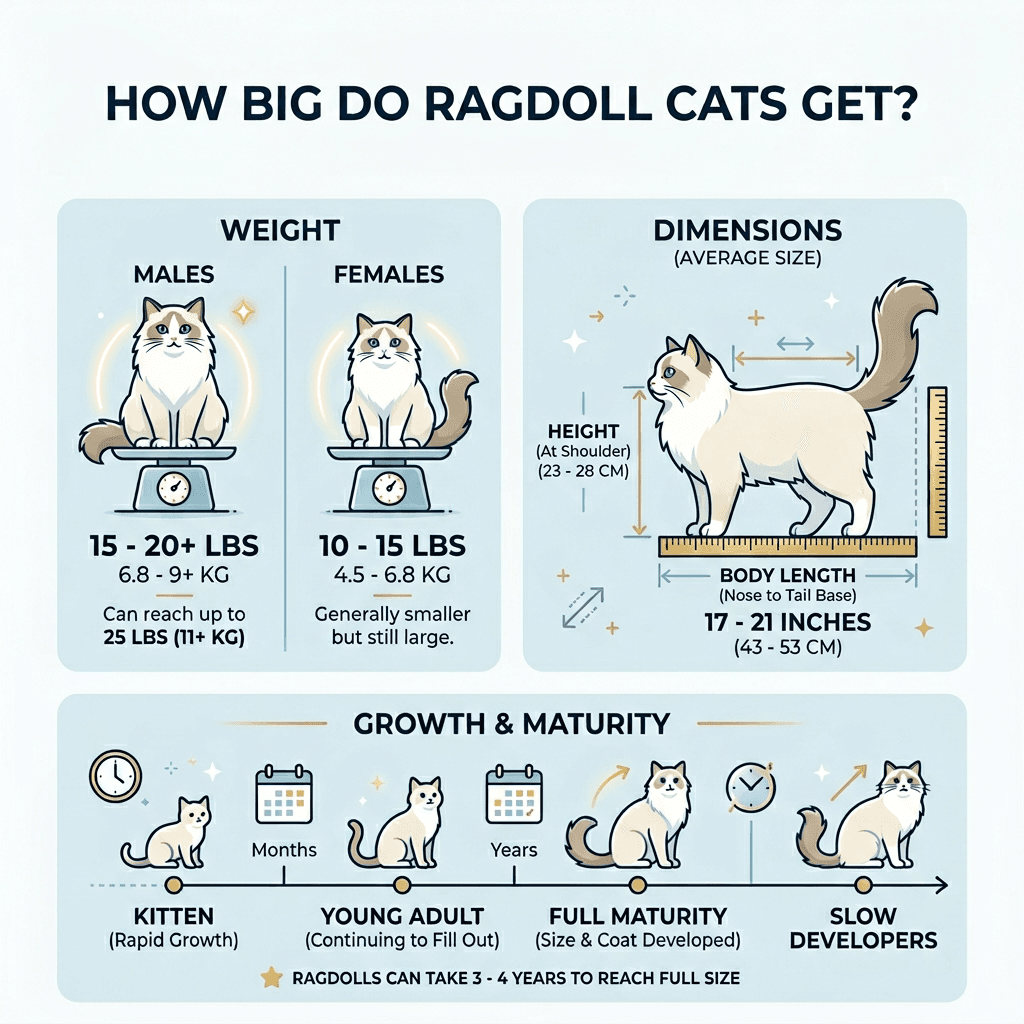
Table of Contents
How Big Are Ragdoll Cats? The Numbers
Ragdoll cats are one of the largest domestic cat breeds in the world. A fully mature male Ragdoll typically weighs between 15 and 25 lbs and stretches 17 to 21 inches in body length, not counting the tail. Females are meaningfully smaller but still large by any domestic cat standard, typically landing between 10 and 15 lbs. Both sexes stand 9 to 11 inches at the shoulder.
How big is a Ragdoll cat in practical terms? Think of a cat that takes up a full chair cushion when they’re curled up, or stretches the entire length of your lap when they sprawl across it. They’re not just fluffy — they have real substance, real muscle, and real presence in a room.
One thing worth saying clearly: how much a Ragdoll cat weighs varies significantly based on sex, genetics, diet, and whether the cat is spayed or neutered. The numbers above are healthy adult ranges — not targets. A well-muscled 20 lb male Ragdoll on a raw diet is not overweight. That’s just what a big, healthy Ragdoll male looks like.
Real Size From Our Own Cats
Most size guides pull averages from the internet. I want to give you something more useful than that — actual numbers from real cats I’ve raised myself. Because when people ask how big Ragdoll cats get, the most convincing answer comes from seeing it firsthand.
Teddy, our Seal Mitted stud, settled at 17 lbs of lean, healthy muscle. Not puffed up, not overweight — just a fully developed adult Ragdoll male doing what Ragdoll males do, which is take up as much space as possible with complete dignity. The photo below is him.
His son Shifu, a Blue Bicolor, was 13 lbs at just 8 months old. Eight months. He was already larger than most domestic cats ever get — and still had years of growth ahead of him. That’s what strong genetics combined with a raw diet from weaning actually produces. It’s one of the reasons we’re so committed to how we raise our kittens here.
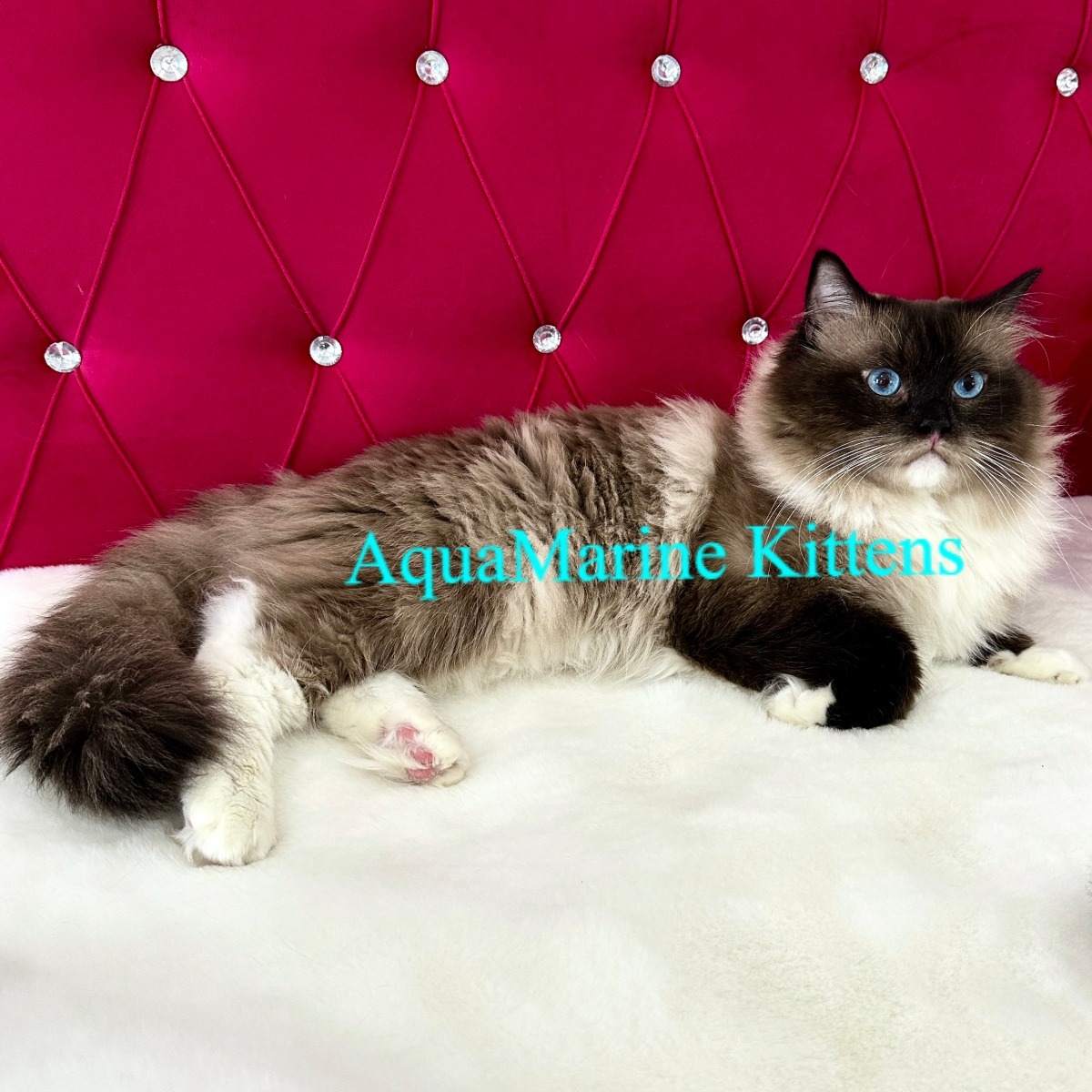
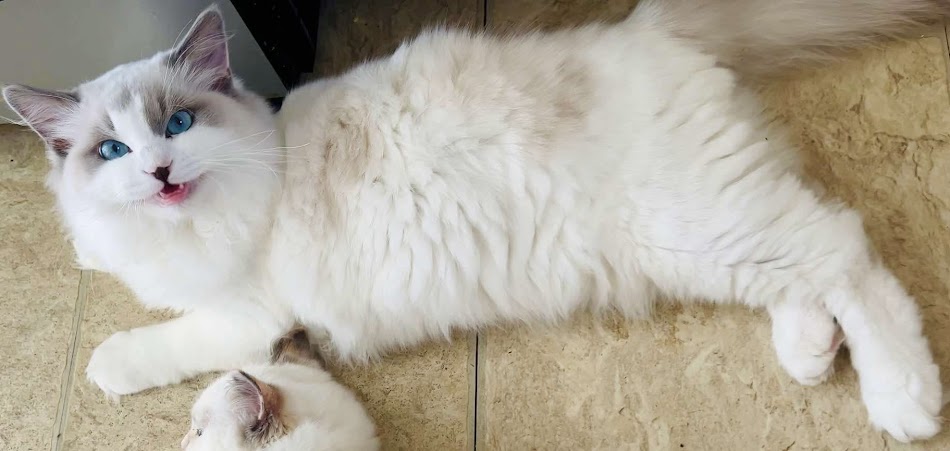
These aren’t exceptional outliers — they’re what happens when genetics, nutrition, and proper care align from day one. How big a Ragdoll cat gets is never just one variable. It’s everything you put into raising them from the start.
Ragdoll Cat Weight by Age
How much do Ragdoll cats weigh as they grow? Here’s the full picture from birth to full maturity. These are real-world ranges based on healthy, well-fed cats — raw-fed kittens from our cattery consistently track at the higher end of these numbers.
| Age | Female Weight | Male Weight |
|---|---|---|
| Birth | 0.2–0.26 lbs (both sexes) | |
| 8 weeks | 1.5–2.2 lbs (both sexes) | |
| 12 weeks | 2.2–3.3 lbs (both sexes) | |
| 4 months | 3.3–4.4 lbs | 4.4–5.5 lbs |
| 6 months | 4.4–6.6 lbs | 5.5–8.8 lbs |
| 8 months | 6.6–8.8 lbs | 8.8–13.2 lbs |
| 12 months | 7.7–12.1 lbs | 9.9–14.3 lbs |
| 18 months | 8.8–13.2 lbs | 12.1–16.5 lbs |
| 2 years | 9.9–14.3 lbs | 13.2–19.8 lbs |
| 3–4 years (full maturity) | 9.9–15 lbs | 15–25 lbs |
| Note: Shifu weighed 13 lbs at 8 months — at the upper end for a raw-fed male with strong genetics. | ||
A pattern you’ll notice: how much a Ragdoll cat weighs at 12 months looks adult, but isn’t. The filling-out phase — broader chest, thicker neck, deeper muscle — continues well into years two through four. A Ragdoll that weighs 14 lbs at one year may be pushing 20 lbs by age three without gaining an ounce of fat. To fully understand that growth timeline, read our dedicated guide: When Do Ragdoll Cats Stop Growing?
Our six-month-old kittens average around 7 lbs, and by eight months the males are already substantial. The biggest single factor in their development is raw feeding from the moment they start on solids — it’s the clearest difference we’ve seen since making that change. For more on our feeding approach, see our guide: Can Cats Eat Raw Meat?
Male vs. Female Ragdoll Size Differences
The size gap between male and female Ragdolls is larger than in most domestic cat breeds — and it’s worth understanding before you choose a kitten, because it directly affects what you’re bringing home.
Male Ragdolls
Male Ragdolls are significantly larger, heavier, and broader than females. They typically weigh between 15 and 25 lbs at full maturity, and they take the longest to get there — most males continue filling out until three and a half to four years old. They develop a characteristic broad, rounded face — what’s often described as the teddy bear expression — along with a thick neck and heavy chest that gives them a real presence in a room despite their gentle, easygoing nature.
How big is a male Ragdoll cat in real terms? Teddy at 17 lbs gives you a solid baseline. Males at the upper end of the range — 20 to 25 lbs — are genuinely large animals. People who’ve never seen a full grown Ragdoll cat up close are always surprised by the actual size.
Tip: If maximum Ragdoll presence is what you’re after, a male is almost always the right choice.
Female Ragdolls
Females are still large cats — don’t let “smaller than males” mislead you. A fully mature female Ragdoll at 10 to 15 lbs is already meaningfully heavier than the average domestic cat, and they carry the same plush, silky coat that makes the breed so distinctive. They tend to finish growing a little earlier than males, usually around two and a half to three years. Their faces are slightly more refined and angular compared to the full, rounded look of the males.
For families who want a more manageable Ragdoll size without giving up the breed’s personality, a female is the most predictable path to that. Same temperament, same coat, just a bit less cat to carry around.
How Ragdoll Size Compares to Other Large Breeds
How does Ragdoll cat size stack up against other large breeds? Here’s an honest side-by-side that puts Ragdoll weight in context across the domestic cat world.
| Breed | Average Male Weight | Average Female Weight | Full Maturity |
|---|---|---|---|
| Ragdoll | 15–25 lbs | 10–15 lbs | 3–4 years |
| Maine Coon | 15–25 lbs | 10–15 lbs | 3–5 years |
| Norwegian Forest Cat | 12–16 lbs | 9–12 lbs | 3–5 years |
| Siberian | 12–16 lbs | 8–12 lbs | 3–5 years |
| British Shorthair | 9–17 lbs | 7–12 lbs | 3–5 years |
| Average domestic cat | 8–10 lbs | 6–9 lbs | 12 months |
The Ragdoll and Maine Coon sit at the very top of the domestic cat size scale — both breeds regularly produce males over 20 lbs. The key differences come down to coat and temperament. Ragdolls have a silky, single-layer coat that needs significantly less grooming than the dense double coat of a Maine Coon or Norwegian Forest Cat. And the Ragdoll personality — calm, trusting, genuinely people-oriented — is in a class of its own. If you want a large cat breed that is also deeply gentle, Ragdolls are hard to beat. Learn more about that side of the breed: Ragdoll Cat Personality: 5 Reasons You’ll Fall in Love.
What Affects How Big a Ragdoll Cat Gets
Not every Ragdoll hits the upper end of the size range, and not every one stays small. How big a Ragdoll cat gets is shaped by several real, measurable factors — and understanding them helps you know what to expect from your specific cat.
Factors That Influence Ragdoll Cat Size
- Genetics and lineage. The single biggest determinant. Ask your breeder about the weight of both parents and previous litters. If the father was 20 lbs and the mother was 12 lbs, you’re getting a big cat. Teddy at 17 lbs passed that frame directly to Shifu — already 13 lbs at 8 months.
- Sex. Males reliably grow larger than females in this breed — often by 30 to 50%. If maximum size is the goal, a male is the most predictable path to it.
- Nutrition. A high-protein, nutritionally complete diet during the growth years makes a direct, measurable difference in adult size and muscle development. Raw feeding is what we use — and the results show up in every litter we raise.
- Spay/neuter timing. Early spay or neuter affects growth plate closure and tends to produce slightly taller, leaner cats. Later neutering generally produces broader, heavier adults. All AquaMarine kittens are spayed or neutered before going home.
- Health during development. Illness, parasites, or nutritional gaps during kittenhood can permanently cap adult size. This is why parasite prevention, vet care, and quality food from weaning are non-negotiable in a serious breeding program.
- Stress and environment. Kittens raised in calm, enriched, socially rich environments develop more fully than those raised in stressful or understimulating conditions. Our kittens live underfoot in a home with five kids — real life, real noise, real people. That foundation shows in how they grow.
Is My Ragdoll Overweight or Just Big?
This is one of the most common concerns Ragdoll owners bring to their vets — and it’s a fair question, because Ragdolls naturally look and feel substantial in a way that can be alarming if you’re not expecting it. How much a Ragdoll cat weighs matters less than how it carries that weight.
A healthy, well-muscled Ragdoll has a lean but substantial frame. You should be able to feel the ribs with light pressure but not see them. The belly should have a gentle tuck — not a swinging pouch — and the cat should feel firm, not soft and doughy. Viewed from above, there should be a visible waist behind the ribs.
An overweight Ragdoll will have a rounded, protruding belly, ribs that are hard to feel, and a general softness throughout the body. This is a very different situation from a large, lean, heavily muscled male who simply weighs 20 lbs because that’s what a healthy male Ragdoll weighs.
Quick Body Condition Check
- Ribs: Easily felt with light pressure, not visible — healthy. Hard to feel under fat — overweight.
- Waist: Visible tuck behind ribs when viewed from above — healthy. No visible waist, oval shape — overweight.
- Belly: Slight upward tuck when viewed from the side — healthy. Rounded, pendulous belly — overweight.
- Overall feel: Firm and muscular — healthy. Soft and doughy — overweight.
If you’re unsure, your vet is the right person to assess body condition — not the scale alone. A 20 lb Ragdoll in great condition is a completely different situation from a 20 lb Ragdoll that’s been overfed on dry kibble for years. Diet makes a real difference: raw feeding produces lean muscle rather than fat-driven weight gain, which is one of the reasons the cats from our program look the way they do.
Why Ragdolls Take So Long to Reach Full Size
One of the most surprising things about the Ragdoll breed is not just how big they get — it’s how long it takes. Most domestic cats reach full size at twelve months. Ragdolls take three to four years. That’s not a slow start; it’s the consequence of building a significantly larger body than most cats ever grow into.
The skeletal system, musculature, and hormonal development all need more time for a breed designed to reach 20-plus pounds than for one topping out at nine. Ragdoll linear growth — height and body length — tends to wrap up around 18 to 24 months. But the filling-out process that follows — the broader chest, thicker neck, and deep muscle mass that define the fully mature Ragdoll — continues well past that point.
A Ragdoll that weighs 14 lbs at one year is not done. Give them another two years of good food and proper care, and that same cat may hit 20 lbs of solid muscle without ever looking overweight. For the complete growth timeline from newborn to full maturity, read: When Do Ragdoll Cats Stop Growing?
Watch: Ragdoll Size in Real Life
Sometimes numbers on a page don’t quite communicate what a fully grown Ragdoll actually looks like in person. This video gives you a real sense of Ragdoll cat size, presence, and how they carry themselves day to day.
Ragdoll cat size in real life — a great visual companion to the numbers in this guide
For further reading on large cat breeds and body condition scoring, the International Cat Care’s body condition guide is an excellent external resource.
Frequently Asked Questions
Our Ragdoll and Cherubim kittens are raised in a real family home — health-tested, raw-fed from weaning, and bred for size, temperament, and beauty. Come see who’s available.
Meet Our Available Kittens