The Complete Guide to Their Size, Stages & Development
When do Ragdoll cats stop growing? If you’ve just brought home a beautiful Ragdoll kitten and watched it sprawl across half your couch, you’re probably wondering exactly that. The answer is: later than you think. Ragdoll cats are one of the slowest-growing and largest domestic cat breeds in the world — and understanding their full development timeline changes how you see every stage of their life.
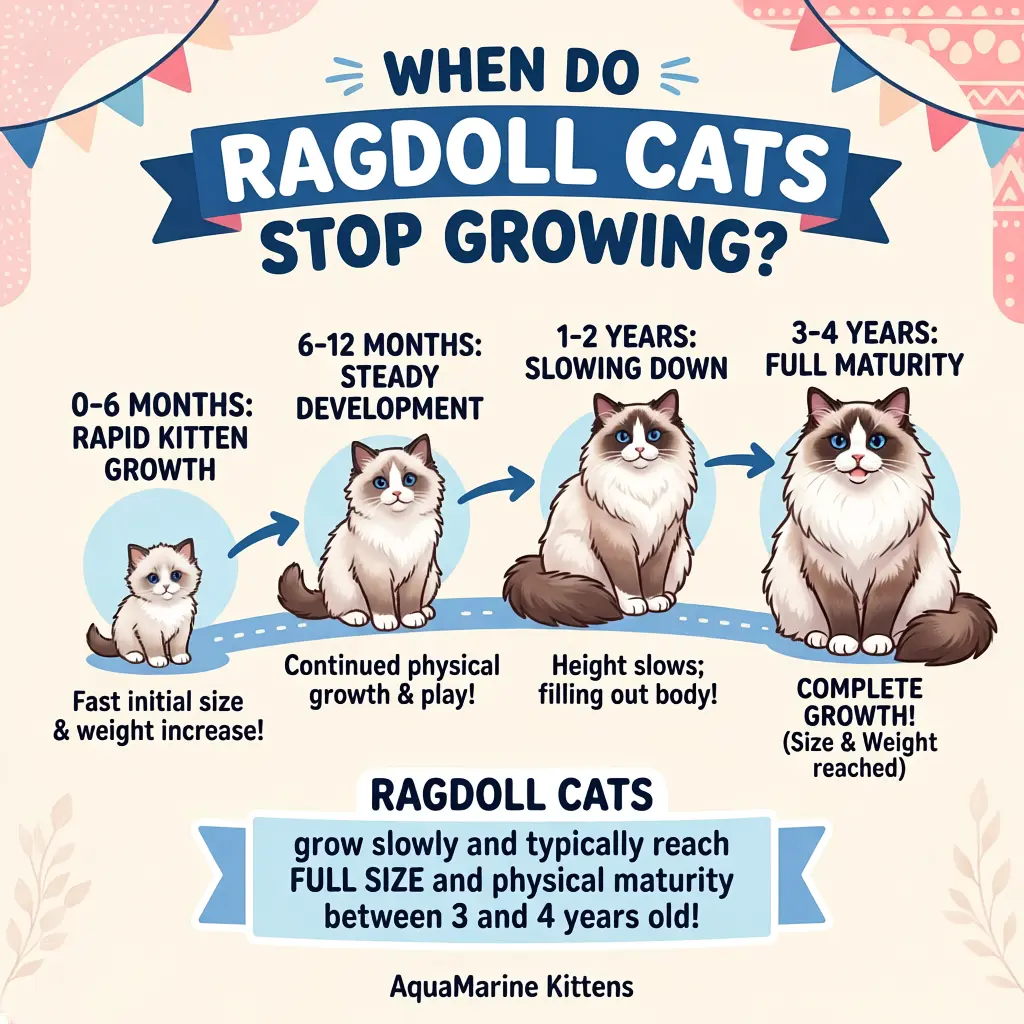
Table of Contents
When Do Ragdoll Cats Stop Growing? The Short Answer
Ragdoll cats generally stop growing at an age between three and four years. Some Ragdoll males, particularly larger ones, continue to fill out and increase their muscle mass up until their fourth year and sometimes even beyond. When do Ragdoll cats stop growing completely? For most, that answer lands squarely at four years old.
Ragdoll cats are certainly unique among their kind. The average domestic cat is physically fully grown by their first year. Larger breeds, like the Maine Coon, are fully grown by their second year. Ragdoll cats reliably fall squarely in the three- to four-year bracket, making them one of the longest-developing breeds of domestic cat you can own.
It is worth making a distinction between two types of growth: linear growth, or getting taller and longer, and developmental growth, or getting filled out, stronger, and heavier. Ragdoll cats appear to have completed their linear growth by as early as eighteen months to two years. They continue to fill out, get heavier, and get stronger for many years afterward. The answer to when do Ragdoll cats stop growing is different depending on what kind of growing you are talking about. The fully grown version of your Ragdoll cat can take many years to arrive.
When they do arrive, however, they are exceptional.
Why Ragdoll Cats Take So Long to Fully Grow
The Ragdoll cat’s long period of development is a function of their size. Larger body masses take longer to develop than smaller body masses — this is true for nearly every species on Earth. The same biological laws that control Great Dane development compared to Chihuahua development apply to domestic cats as well. The size of an animal determines how long it needs to develop in order to be fully grown.
Ragdoll cats are one of the largest breeds of domestic cat in the world. According to TICA’s Ragdoll breed standard, the Ragdoll is a large, muscular cat with a broad chest and heavy bone structure — traits that simply take longer to develop than those of a smaller breed. A mature, adult male Ragdoll cat can weigh anywhere from fifteen to twenty-five pounds, and that is real muscle and bone, not just fluff. The skeletal system, the muscles, and the hormonal systems that control everything in the body just need more time to develop than a cat that is only supposed to weigh eight pounds.
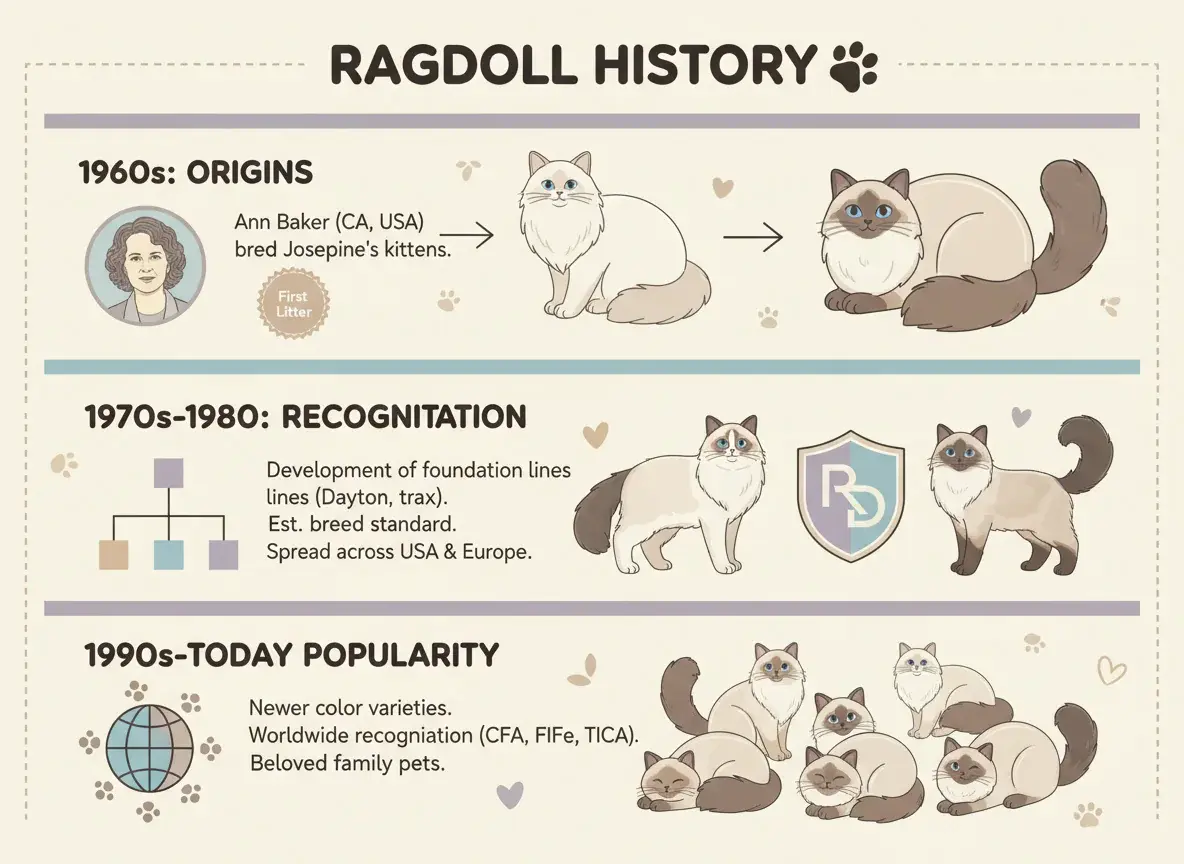
There is a genetic factor that is specific to this breed, too. The genetic makeup of the Ragdoll cat was created specifically to be a big cat from the very beginning. Ann Baker, the founder of the breed, was specifically looking to create a big cat, along with a friendly temperament, in 1960s California. This genetic makeup, specifically designed to create a very big cat, also comes equipped with a very big development timeline.
This is very helpful information to know, especially to a new owner of a Ragdoll cat. If your six-month-old Ragdoll cat is not looking anything like the big, plush adult Ragdoll cat that is in all of the pictures, don’t worry — they will get there. It is just a longer timeline than most people are used to hearing about when they first ask, when do Ragdoll cats stop growing?
Ragdoll Cat Growth Stages: From Birth to Full Maturity
This is the most detailed explanation of the different stages of growth in a Ragdoll cat, from birth to full maturity. Understanding each stage helps answer when do Ragdoll cats stop growing — and what to expect along the way.
Newborn (0–2 Weeks)
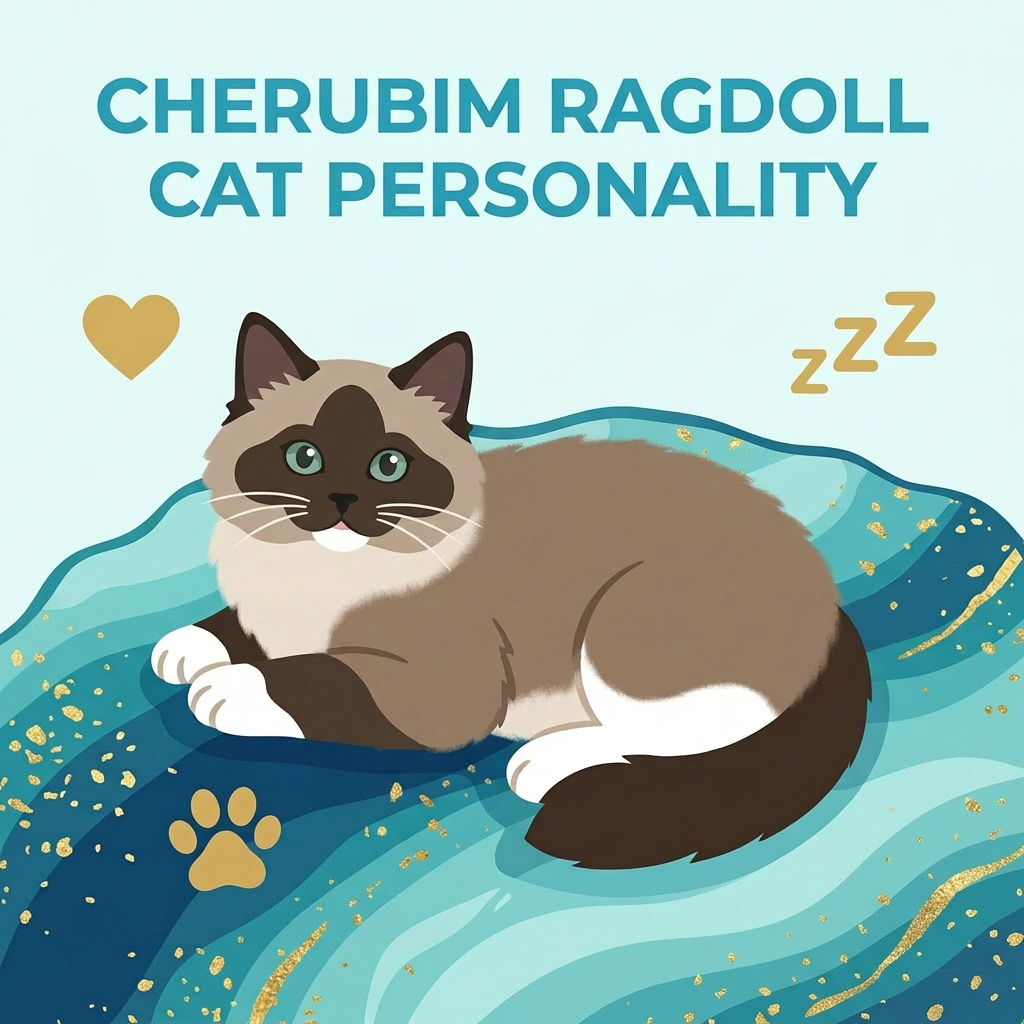
Ragdoll kittens are born very small, with a birth weight of between 90 to 120 grams. Traditional Ragdolls are born white, with no signs of color whatsoever. The colors will appear over the following weeks. The colors of the Cherubim kittens, i.e., mink, sepia, and solid, appear from birth, which is one of the most prominent visual differences between the two breeds.
At this point, the kittens are totally dependent on the mother. The eyes and ears of the kittens are closed, and they cannot regulate their own body temperatures. All they do is nurse, sleep, and grow, which they do rapidly. A healthy Ragdoll kitten should increase its birth weight approximately twofold within the first two weeks of its life.
Early Development (2–4 Weeks)
The eyes of the kittens open between the ninth to fourteenth days. The kittens’ ears also start to function during this time. The kittens take their first steps during this time, which, though adorable, are quite clumsy. The baby teeth of the kittens appear during this time, too.
Socialization begins during this phase. The kittens start to socialize with one another, becoming aware of the people surrounding them. Handling them during this phase starts to shape the confident personalities of the Ragdoll kittens.
Weaning and Socialization (4–8 Weeks)
This phase of the Ragdoll kittens’ lives is one of the most important. The kittens, during this phase, start to get used to eating food other than the mother’s milk. The food should be introduced gradually, with wet food being introduced gently alongside the mother’s milk.
Physically, it is a period of rapid and obvious growth. The kitten is beginning to resemble a cat. The coloring is becoming more defined in pointed Ragdolls. Mink and sepia-colored kittens will darken and become richer as time progresses.
Perhaps even more important is the socialization aspect. Kittens socialized during this period will become confident adult cats. Kittens socialized between weeks four and twelve will be much less likely to have behavior problems. At AquaMarine Kittens, our kittens are underfoot during this entire period. They live in the middle of our home with five children, lots of noise, and life in general. This is an important period.
Active Kitten Phase (8–16 Weeks)
This is the time when the majority of the Ragdoll kittens go to their new homes. The average time is twelve to sixteen weeks. A responsible breeder will at least wait twelve weeks before allowing their kittens to go to their new homes. It is a time of rapid growth and development. The kitten is full of energy and likes to play. The kitten is curious and wants to explore the world. The kitten is burning with energy at a rate that will never again be seen.
Physically, the kitten is growing at a rate that is quite obvious. The kitten is becoming substantial in size. It is larger than the average household kitten at this same time. The kitten is becoming silky in appearance.
Nutrition is important at this time. The kitten must have a high-protein diet to keep the rapid growth going. This is the reason we feed our kittens raw meat as soon as they begin eating solids. The results far surpass anything we ever got before making the change.
Adolescence (4–12 Months)
This is the stage of development where the Ragdoll cat growth spurt often comes as a surprise to new owners. Between four and twelve months of age, Ragdoll cats go through a rapid growth spurt in height, length, and weight. It is a startling growth rate if you didn’t know what to expect. You’ll probably be buying larger portions of cat food and thinking about whether that cat tree was really as tall as you thought.
Behaviorally, the young Ragdolls at this stage are energetic and playful but are also beginning to show the temperament of the adult cat. It is not uncommon for young Ragdoll cats to go through a slightly “lanky” or “awkward” phase of development as their limbs and body grow faster than their mass develops. This is a totally normal and temporary development phase.
At twelve months of age, Ragdoll cats tend to resemble adult cats in appearance. It is common at this stage for owners to believe that development is complete. It is not. Not by a long shot.
Young Adult Continued Development (1–2 Years)
Ragdoll cats at this stage will continue their development but at a significantly slower rate than in the first year of life. It is during this time that the “filling out” of the body begins. The chest expands, the neck thickens, and the muscles begin to fill out. The Ragdoll cat begins to take on the characteristics of the full adult.
This is also the time when the development of the cat’s coat is completed. It is not uncommon for a Ragdoll cat not to develop its full coat until eighteen or twenty-four months of age.
Full Maturity — When Ragdoll Cats Stop Growing (2–4 Years)
This is the final stretch of the development of the Ragdoll cat, and the direct answer to when do Ragdoll cats stop growing. It is during this time that the body is finishing the development of mass, muscle density, and the breadth of the chest.
Male Ragdoll cats, in particular, often surprise their owners during this period. A cat which already seemed large will continue to broaden and fill out, adding what can only be described as a completely different level of substance and presence. By the end of this period, the fully mature male Ragdoll cat is a truly imposing, magnificent creature, and nothing like the small kitten which arrived just a few years before.
Females tend to achieve full size a little earlier, around two and a half to three years, and carry slightly less mass than the males.
Ragdoll Cat Weight by Age — What to Expect
This is the information which most Ragdoll cat owners are looking for when asking when do Ragdoll cats stop growing. These weights are approximate, and individual variations can occur. Ragdoll cat kitten weights tend to be at the high end of the scale if the kittens are raw-fed, as ours are in our breeding cattery.
- Birth 90–120g
- 2 weeks 180–250g
- 4 weeks 300–450g
- 8 weeks 700g–1kg
- 12 weeks 1–1.5kg
- 4 months 1.5–2.5kg
- 6 months 2–3.5kg
- 9 months 3–5kg
- 12 months 3.5–5.5kg (female) | 4.5–6.5kg (male)
- 18 months 4–6kg (female) | 5.5–7.5kg (male)
- 2 years 4.5–6.5kg (female) | 6–9kg (male)
- Full maturity (3–4 years) 4.5–6.5kg (female) | 6–11kg (male)
A note on these numbers: Ragdoll cat weight is genuinely variable and greatly dependent on genetics, nutrition, and spayed/neutered status. A well-muscled male Ragdoll on a raw diet is NOT overweight. He’s built that way. The objective is lean, healthy muscle with good condition, not a number on a scale.
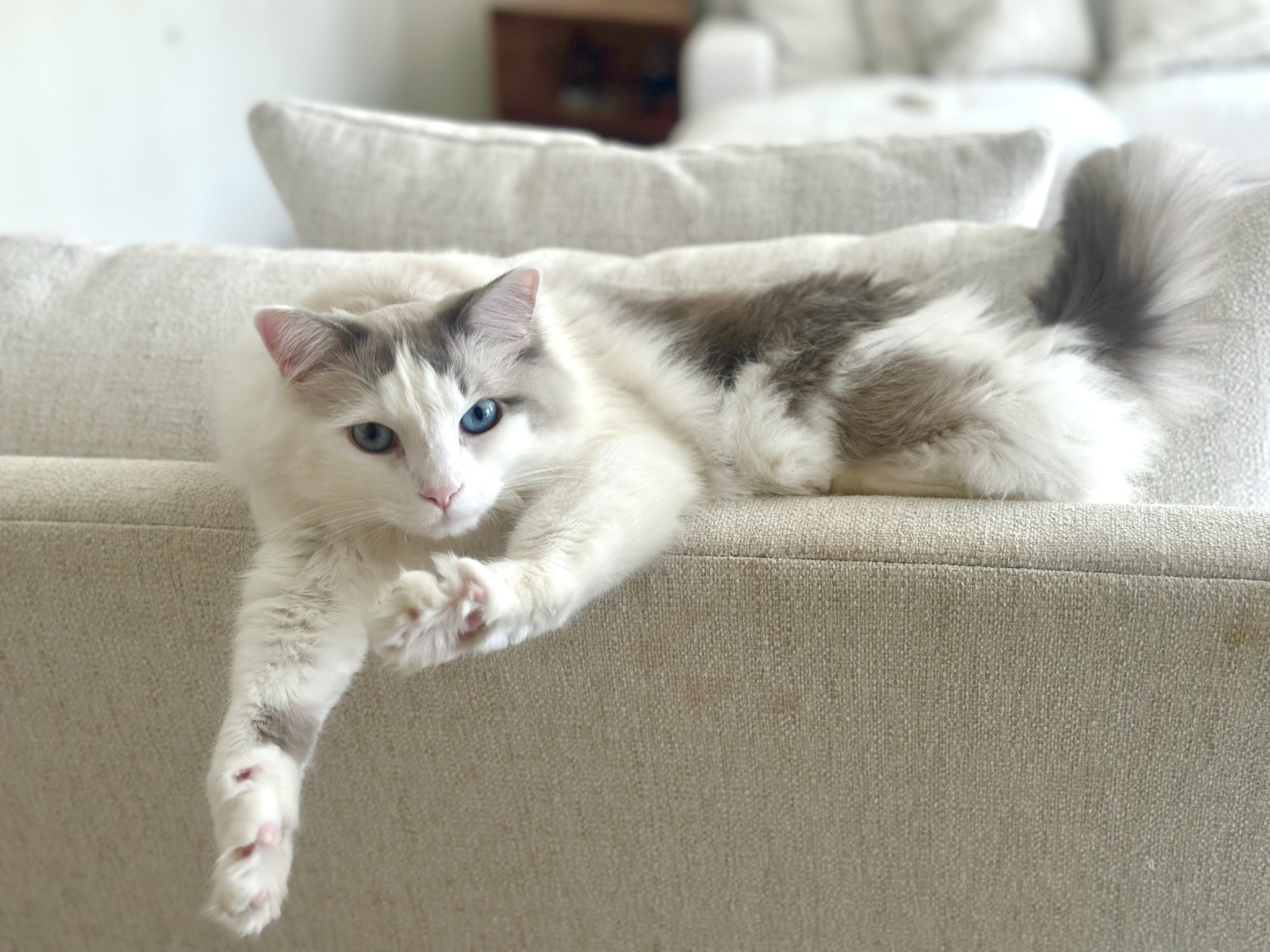
Blue Bicolor Ragdoll stretched out on the couch — 2 years old at 20 lbs, and still not fully grown. A perfect example of when do Ragdoll cats stop growing in action.
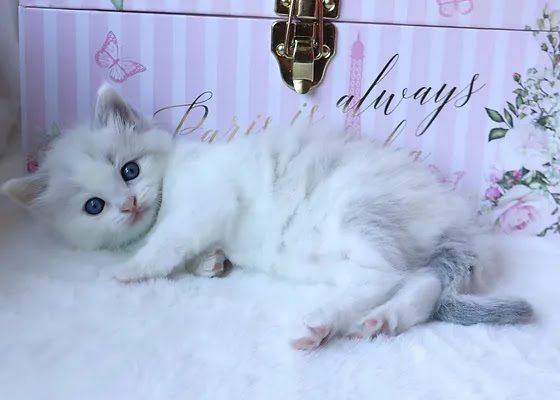
The same Blue Bicolor line at 5 weeks old — around 2 lbs. This is why people ask when do Ragdoll cats stop growing — the transformation is extraordinary.
Male vs. Female Ragdoll Cat Growth Differences
The size differences between male and female Ragdoll cats are much greater than in many other breeds. Knowing why is important for understanding what to expect as your Ragdoll cat grows.
Males will grow larger, heavier, and will continue to develop for a much longer period. They will continue to fill out until they are three and a half to four years of age. Sometimes, male Ragdoll cats will continue to develop even longer. The final mass of a mature male is considerably heavier than a female of the same lineage. Males will also have a wider, rounder face with a softer expression — what is called a ‘teddy bear face’ — along with a heavier neck and chest.
Females will be considerably smaller and will finish growing a bit earlier, at two and a half to three years of age. They are still large cats by any standard, but lighter and less massive than males. Females have a much more refined, slightly more angular face compared to males.
While there are differences between males and females, both have the same temperament, coat quality, and overall build. The differences are purely physical. For families who want a smaller Ragdoll cat, a female is generally a better choice. For families who want a Ragdoll cat with maximum presence, a male is generally a much better choice.
What Affects How Big Your Ragdoll Cat Will Get
There are a number of factors that affect the final size of your Ragdoll cat. Understanding these factors helps manage expectations and gives you the tools you’ll need to ensure the development of a healthy cat.
Key Factors That Influence Ragdoll Cat Size
- Genetics and Lineage — This is the single biggest factor in the size of the adult Ragdoll cat you’ll end up with. If you come from a line of large, well-built cats, you’ll end up with a large, well-built adult. We’d be happy to tell you what the weights of our breeding cats are and how their previous kittens have grown.
- Sex — As mentioned above, male Ragdoll cats grow significantly larger than females. If you want a large cat, this is one of the more predictable variables.
- Nutrition During Development — This is a huge factor that is often underestimated. A Ragdoll cat kitten provided with a nutritionally complete, high-protein diet while developing will grow more fully than one provided with a poor-quality diet. This is another reason we feed our kittens a raw diet from the time we wean them. The difference in muscle development, coat quality, and body condition of our raw-fed kittens is dramatically better. Our six-month-old kittens average around 10 lbs.
- Spay and Neuter — Early spay or neuter has been shown to result in slightly taller, leaner Ragdoll cats because of the effect on growth plates. Later neutering results in cats that are broader and heavier. It’s not a huge difference, but it is a difference nonetheless. We spay or neuter all of our kittens before we send them home.
- Overall Health — Any illness, parasites, or nutritional problems during the development period can limit a Ragdoll cat’s growth. Veterinary care, anti-parasite treatments, and good nutrition during the first two years are essential for the adult cat your kitten grows up to be.
- Environment and Stress Levels — There is a proven effect of stress on a cat’s development. A calm environment, proper socialization, and lack of constant stressors during the early Ragdoll kitten development period will result in a more fully developed adult cat.
Signs Your Ragdoll Cat Has Stopped Growing
As you can tell from the lengthy and gradual nature of a Ragdoll cat’s development, it is difficult to tell exactly when do Ragdoll cats stop growing. However, the following signs indicate that your Ragdoll cat has finished growing and has reached full maturity:
- Weight stabilization. When your Ragdoll cat’s weight has remained constant for three or more months without any changes to their diet, this is a sure sign that they have finished growing. While they may still be developing some density to their muscles, active growth is over.
- Chest and shoulder width. The development of the chest and shoulder area is the last thing to finish in a male Ragdoll cat. When this area feels fully developed and no longer appears to be changing, you can assume that your Ragdoll cat has finished growing.
- Face shape has rounded fully. The Ragdoll cat has a wide, rounded face, full cheeks, and wide-set eyes. It is only when the face appears fully rounded and the jowls have filled in that you have the adult expression.
- The coat is fully developed. When the coat looks dense, full, and uniform, and there has been no visible change from month to month — the Ragdoll cat growth process is complete or nearly complete.
Nutrition and Its Role in Ragdoll Cat Growth
Any discussion of when Ragdoll cats stop growing would not be complete without discussing nutrition, as it plays a significant role in the adult cat your Ragdoll becomes. According to the Cornell Feline Health Center, cats are obligate carnivores whose bodies are designed to digest and process animal protein efficiently — and that need is at its highest during the growth years.
A high concentration of animal protein in the Ragdoll kitten’s meals provides the tools needed for muscle, bone, and coat development, as well as the immune system, which continues to develop until the Ragdoll cat reaches full maturity.
Raw feeding is the method we use in our cattery, and the end result speaks for itself. Our studs and queens are in significantly better body condition than when we were feeding premium kibble. Our queens return to health faster from weaning, and our Ragdoll kittens grow stronger and more robust.
If raw feeding is not appropriate for your situation, then a high-quality wet food with a named meat as the first ingredient and no grains or fillers is the next best choice. Dry food only is the worst choice for a growing Ragdoll cat, mostly due to moisture levels and carbohydrate content.
For more on what we feed and why, check out our guide: Can Cats Eat Raw Meat? 7 Things Every Owner Should Know.
Common Ragdoll Cat Growth Questions Answered
Ragdoll cat growth and development — a great visual companion to this guide
Frequently Asked Questions About When Ragdoll Cats Stop Growing
Final Thoughts on When Ragdoll Cats Stop Growing
When do Ragdoll cats stop growing? The truth is, later than you might think — which just goes to prove one of the most wonderful aspects of the breed: you get to see something slowly come into its own. A tiny little kitten, a spotty little teenager, a gangly young cat, a substantial young adult, and finally, around year three or four, a magnificent Ragdoll cat in its full, glorious self.
It’s one of the joys of owning a Ragdoll cat: the patience required is minimal, the rewards substantial.
If you’re currently caring for a Ragdoll kitten and wondering when the growing will cease — relax, feed them well, and enjoy the process. The final product is on the way. It’s just taking the time it’s taking.
Our Ragdoll and Cherubim kittens are raised in a real family home — health-tested, raw-fed, and socialized from birth. Come see who’s available.
Meet Our Available Kittens