The Ragdoll Cat Origin Story: 7 Fascinating Facts About How One Woman and a Feral Cat Built the World’s Most Beloved Breed
Most cat breeds have tidy, well-documented histories. The Ragdoll cat origin story is not that. It starts with a feral white cat named Josephine in 1960s California, an eccentric breeder named Ann Baker with some very unusual claims, and a split that nearly tore the breed apart before it even got started. It’s one of the stranger stories in the cat world — and knowing it makes you appreciate the breed even more.
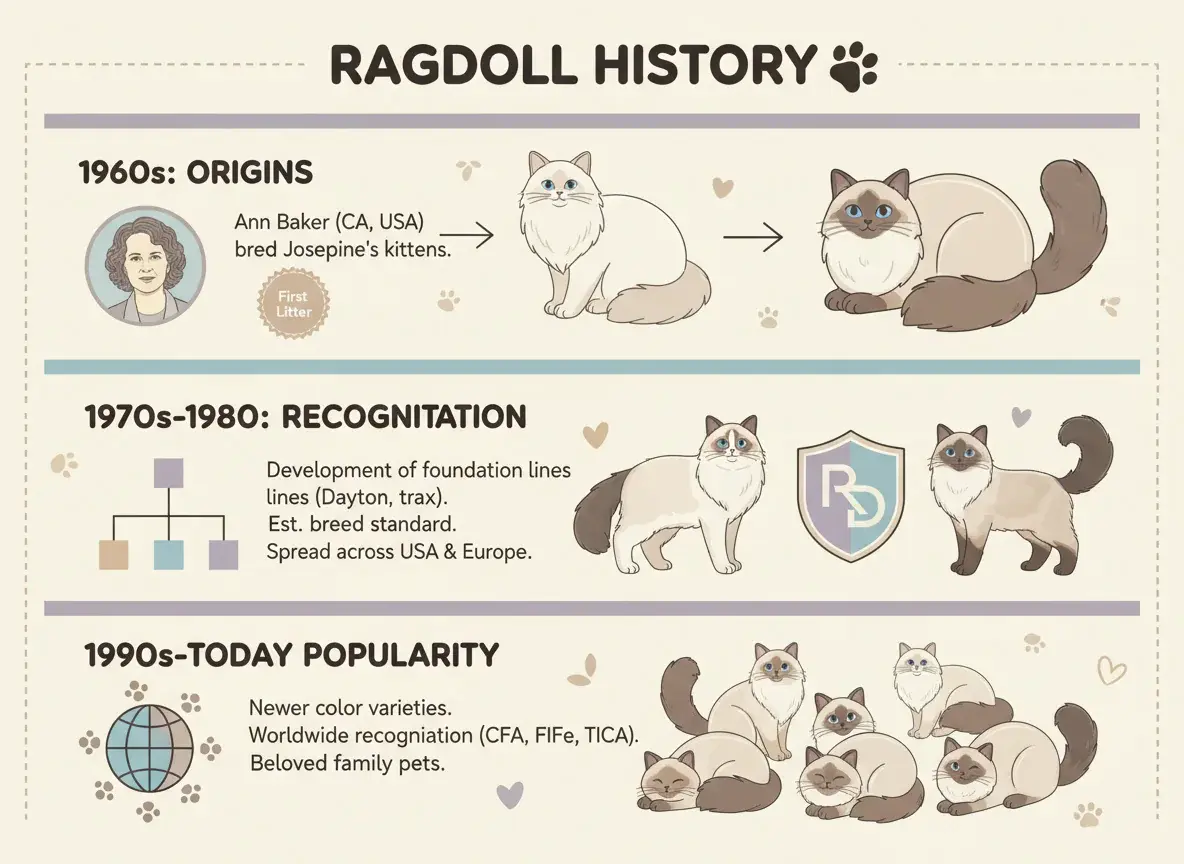
Table of Contents
It All Started With Josephine
The history of Ragdoll cats begins not with a careful breeding program, but with a feral white cat living on a property in Riverside, California. Her name was Josephine, and she belonged to Ann Baker’s neighbor, Merle Pennels. Josephine was a non-pedigreed, white longhaired cat — described as Angora-type in appearance. She was essentially a stray who had made herself at home.
For years, Josephine produced litters of typical feral kittens — wild, unsocialized, not particularly people-friendly. Then something changed. In the early 1960s, she began producing kittens with noticeably different temperaments. Calm. Floppy when held. Affectionate and trusting in a way her earlier litters hadn’t been. Ann Baker, who lived nearby and had an eye for cats, noticed immediately — and those kittens became the foundation of everything.
What caused the change in Josephine’s kittens is still debated. Baker had her own theories — some fairly wild, including claims about genetic engineering and pain resistance that have been widely dismissed. The more likely explanation is that Josephine was bred with a calm, docile male and Baker selectively continued those temperament traits through careful breeding. That process is the true Ragdoll cat origin.
Ann Baker made some extraordinary claims over the years — that Ragdolls were immune to pain, that their docility resulted from genetic alteration, and even that government experiments were somehow involved. One of the more persistent stories was that Josephine had been in a car accident before producing her notable litters, and that the trauma had permanently altered her genetics, passing those traits to her kittens. There is no scientific basis for any of this. Cats cannot pass on traits acquired through injury or accident, and the breed’s calm temperament is simply the result of careful, selective breeding — nothing more.
Ann Baker: The Woman Who Built the Breed
To understand the Ragdoll cat origin, you have to understand Ann Baker. She was a breeder in Riverside, California — determined, passionate about her cats, and by most accounts fiercely protective of what she was creating. She was also, depending on who you ask, genuinely eccentric. Without her vision, the history of Ragdoll cats simply doesn’t exist.
Baker recognized something special in Josephine’s kittens and began acquiring them to develop a new breed. She was meticulous about the traits she wanted — the large size, the plush semi-longhair coat, the colorpoint patterns, and above all, that signature gentle temperament. Over time, through careful selection, she shaped what we now know as the Ragdoll.
But Baker’s business instincts complicated everything. She trademarked the name “Ragdoll” — a move almost unheard of in the cat world — and founded her own registry, the International Ragdoll Cat Association (IRCA) in 1971. Breeders who worked with her cats had to sign contracts dictating how they could be bred, named, and sold. She even attempted to franchise breeding like a business model, collecting royalties and maintaining tight control over every aspect of the breed’s development.
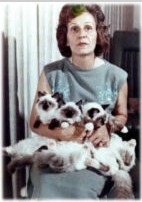
Ann Baker with seal mitted and seal pointed kittens — the woman behind the Ragdoll cat origin story.
The Three Foundation Cats
The breed as we know it today is built on three cats — all descended from Josephine. Understanding them is understanding the Ragdoll cat origin at its core.

The Split That Saved the Breed
By the mid-1970s, tension between Ann Baker and the broader community of breeders had reached a breaking point. The trademark, the strict IRCA licensing requirements, the refusal to register cats with any other association — it was all too restrictive for people who wanted to advance the breed properly and gain mainstream recognition.
In 1975, a husband-and-wife team named Denny and Laura Dayton broke away from the IRCA. They had purchased the first breeding pair Baker ever sold — a pair named Rosie and Buddy, in 1969 — and had been developing the lines carefully ever since. Their goal was simple: get the Ragdoll recognized by legitimate cat associations and establish a real breed standard.
This was harder than it sounds. Baker’s trademark on the name was real and legally enforceable. The Daytons had to fight for recognition on multiple fronts simultaneously — building a breed standard, lobbying cat associations, and maintaining the breeding program all at once. It took years. But they got there, and in doing so secured the future of the entire history of Ragdoll cats.
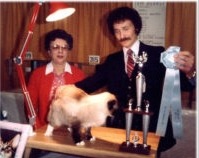
Blanche Herman with her famous Ragdoll, Perrywinkle, being judged by ACFA judge Tom Herbst — who awarded Perry Best Alter in Show. A beautiful piece of Ragdoll show history.
From Obscurity to Most Popular Breed in the World
The breed’s path to mainstream recognition was gradual but steady. In the early 1980s, a breeding pair was exported to the UK, followed by eight more cats to fully establish the breed there.
What About the Ragamuffin?
As a footnote to the history of Ragdoll cats: in 1994, another group of breeders split from Baker’s IRCA over her increasingly strict rules. Because Baker still held the “Ragdoll” trademark, this group couldn’t use the name. They developed their own breed standard under the name Ragamuffin, which TICA recognized in 2003 and CFA in 2011.
Ragamuffins share common ancestry with Ragdolls and have a similar temperament, but are a distinct breed with their own standard — any color or pattern, including non-pointed, with a slightly rounder facial structure. The Ragdoll cat origin story is woven into theirs too.
The Ragdoll Cat Origin and What It Means Today
Understanding where Ragdolls came from matters more than it might seem. The breed was built — deliberately, through decades of careful selection by Ann Baker and those who came after her — for temperament first. The calm, the patience, the affection, the way they just fit into a household and bond with the people in it: those aren’t accidental. They were the whole point from the beginning.
The history of Ragdoll cats also explains why socialization matters so much. A breed developed to be trusting and people-focused still needs proper early handling to reach its potential. That’s what we focus on here at AquaMarine Kittens — raising kittens underfoot, in a real home with five kids and real daily life, so they arrive with their new family already comfortable with everything a household brings.
Ragdoll Cat Origin: Key Facts
- Developed in Riverside, California in the early 1960s by Ann Baker
- All Ragdolls trace their lineage to one feral cat — Josephine
- Three foundation cats: Daddy Warbucks, Fugianna, and Buckwheat
- The Dayton family’s 1975 breakaway led to mainstream breed recognition
- CFA registered 1993, championship status 2000
- Ranked the most popular cat breed in the world by CFA in 2023
- The Ragamuffin breed shares common origins but is now a separate breed
For the full official breed standard and detailed history, the Cat Fanciers’ Association Ragdoll page and the TICA Ragdoll Breed page are both worth a read. If you want to go even deeper, History of Ragdolls is a wonderful resource with a large collection of historical images and records.
Frequently Asked Questions
Decades of careful breeding went into creating the Ragdoll we know today. See the kittens we’re raising right now — each one a piece of that history.
Meet Our Available Ragdoll & Cherubim Kittens